Key takeaways
- The bottleneck: A national clinical research network (4M+ patients) was losing 36 hours per month per protocol to manual EHR chart reviews while suffering a 52% screen failure rate on a complex cardiology weight-loss trial.
- The fix: The network integrated Recruit by Mahalo Health directly into its NextGen EHR and CRIO CTMS, parsing six complex trial protocols into toggleable Inclusion/Exclusion (I/E) criteria cards in under 10 minutes.
- The impact (6 months): Manual chart review dropped by 93% (to 2.5 hours/month), screen failure rates plummeted from 52% to 14%, 500 trial-ready patients were prioritized, and monthly enrollment doubled (2x)—with 5 high-probability candidates booked for screening prior to the Site Initiation Visit (SIV).
The silent killer of clinical trials isn’t patient scarcity—it’s search friction
The clinical research industry loves to blame "patient apathy" for missed timelines. The data tells a different story.
The Tufts Center for the Study of Drug Development found that 11% of sites in a given trial fail to enroll a single patient and 37% under-enroll, and that study timelines typically stretch to nearly double their original length to reach enrollment targets (Tufts CSDD Impact Report, January/February 2013). Yet the root cause at the site level is rarely a lack of eligible humans in the database. Instead, eligible patients stay buried inside Electronic Health Records (EHRs) because traditional discovery methods are fundamentally broken:
- Social media ads are a high-cost lottery: Broad digital outreach floods understaffed sites with unqualified leads, driving up screen failure rates and coordinator fatigue.
- Legacy EHR queries are blunt instruments: Standard SQL reports and basic keyword searches can't interpret nuanced, multi-layered clinical exclusion criteria.
- Feasibility is built on guesswork: Without instant visibility into structured and unstructured chart notes, sites commit to protocols based on gut feel rather than verified cohort counts.
When a prominent national site network serving 4 million patients took on a high-stakes weight-loss trial for Acute Coronary Syndrome (ACS) at its flagship cardiology site, these three friction points collided.
The breaking point: 36 hours of manual chart reviews for a single protocol
Cardiology and metabolic trials carry notoriously intricate Inclusion/Exclusion (I/E) parameters. To hit aggressive sponsor milestones, the network’s Clinical Research Coordinators (CRCs) were relying on physician referrals, social campaigns, and manual EHR digging.
The math simply didn't scale:
- 36 hours lost monthly: CRCs spent nearly a full workweek every single month manually combing through NextGen EHR charts for just one protocol.
- A 52% screen failure rate: More than half of the patients brought in for screening washed out, burning budget, investigator time, and staff morale.
- Login fatigue: Overburdened staff were already juggling multiple disconnected software portals; adding another clunky standalone tool was a non-starter.
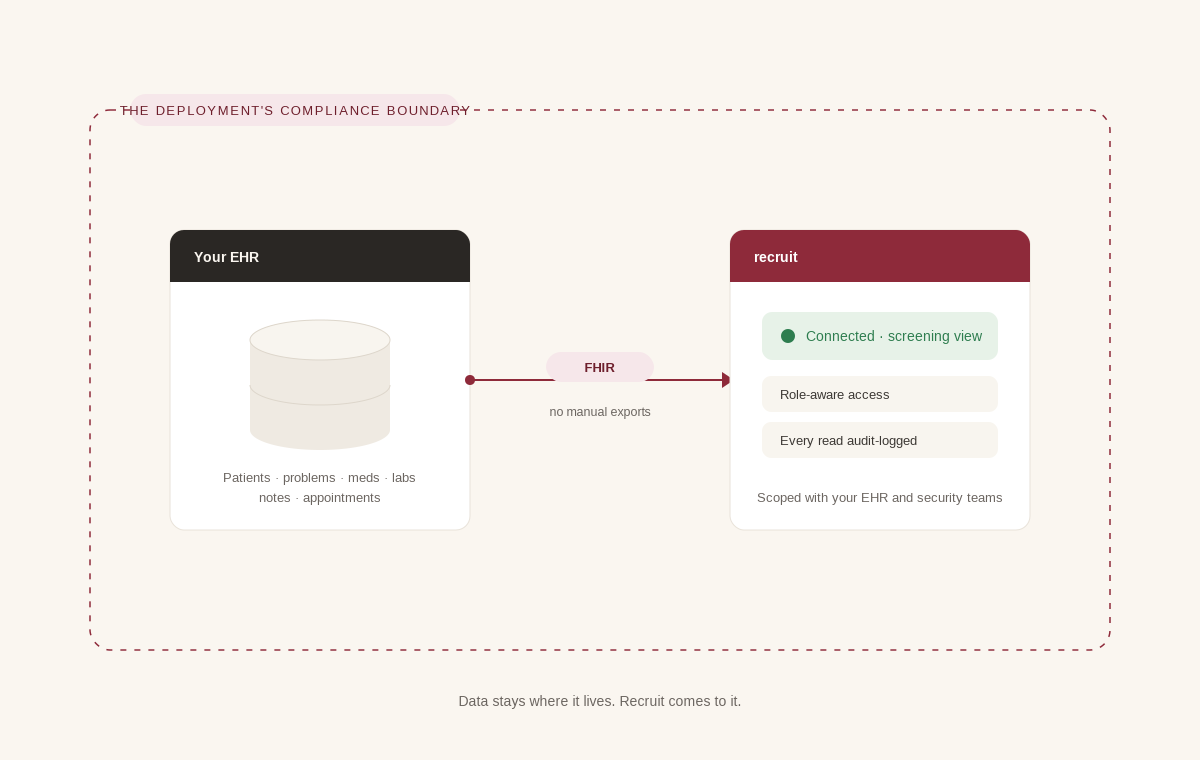
To win top-tier sponsor contracts and rescue their timelines, the network needed an AI layer that lived inside their existing clinical ecosystem, respected strict healthcare compliance boundaries, and eliminated manual chart hunting. They partnered with Recruit by Mahalo Health.
Manual EHR chart review
36 hours
chart review per protocol, per month
52%
screen failure rate
Recruit by Mahalo Health
2.5 hours
chart review per protocol, per month
14%
screen failure rate
The solution: Turning static protocols into live EHR filters in 5 to 10 minutes
Instead of forcing coordinators to translate dense 150-page PDFs into manual EHR filters, Recruit by Mahalo Health reengineered the site's intake workflow from the ground up.
Single-tenant security from day one
Enterprise health networks cannot afford data commingling. Before touching a single patient record, Mahalo deployed a strict client data isolation architecture—provisioning dedicated cloud storage buckets with unique, tenant-specific encryption keys. With configurable controls that support HIPAA and FDA 21 CFR Part 11 workflows, the platform cleared IT security hurdles in just 1 to 2 weeks.
"Toggle-ready" protocol parsing
Once integrated directly with the site’s NextGen EHR and CRIO CTMS, the site coordinator uploaded six complex cardiology and metabolic protocols. Within 5 to 10 minutes, Mahalo’s AI parsed the dense medical text into discrete, interactive Inclusion and Exclusion Criteria Cards.
Coordinators could toggle specific criteria on or off in real time to model cohort sizes, adjust for protocol amendments, and immediately surface hundreds of pre-qualified candidates across all six studies—complete with transparent audit trails for Principal Investigators and sponsors.
Operational standardization across the network
Software alone doesn't enroll patients; process does. Through weekly 1:1 optimization sessions and a built-in, one-click "In-App Feedback" loop, Mahalo helped leadership spot hidden operational leaks. For example, previously, individual CRCs decided arbitrarily how many times to follow up with a prospective participant. Armed with high-precision match lists, leadership standardized outreach cadences across the entire site network, prioritizing warm outreach during patients' upcoming scheduled clinic visits.
“I love how easy it is to use. Our site coordinator really took the reins and now we're turbocharging our site!”
The 30-day deployment blueprint
Clinical sites often dread software implementations that drag on for quarters. Here is the exact rollout timeline achieved with Recruit by Mahalo Health:
| Implementation phase | Turnaround time | Key deliverables & milestones |
|---|---|---|
| IT security & sign-off | 1–2 weeks | HIPAA, SOC 2 Type II and FDA Part 11 review; single-tenant cloud isolation setup. |
| Ecosystem integration | 1 day – 4 weeks | 1-day API hookup for existing EHRs (2–4 weeks for net-new EHRs like NextGen); 2 weeks for CRIO CTMS sync. |
| Staff onboarding | 1 day | Live 1:1 coordinator training and activation of the real-time in-platform feedback loop. |
| AI protocol parsing | 5–10 minutes | Automated ingestion of 6 complex protocols into interactive I/E toggle cards. |
| Patient identification | Real-time | Instant prioritization of 500+ trial-ready candidates with full clinical audit trails. |
The results: Pre-stacking the pipeline before the SIV
Six months post-launch, Recruit by Mahalo Health hadn't just sped up administrative tasks—it had fundamentally changed the economics of the cardiology site, becoming its #1 source of enrolled patients (accounting for a full 50% of all randomized participants, matching all non-EHR sources combined).
Before vs. after: 6-month site performance
| Operational metric | Legacy manual workflow | With Recruit by Mahalo Health | Net impact |
|---|---|---|---|
| Monthly CRC chart review time | 36 hours / protocol | 2.5 hours / protocol | >93% time saved |
| Trial screen failure rate | 52% | 14% | 73% reduction in screen fails |
| Monthly enrollment velocity | Baseline (1x) | 2x monthly enrollments | 100% increase in speed |
| Pre-SIV pipeline readiness | 0 pre-booked patients | 500 pre-screened / 5 booked pre-SIV | Day-one enrollment momentum |
Winning the trial before day one
In clinical research, the weeks immediately following the Site Initiation Visit (SIV) make or break sponsor confidence. By running Mahalo’s AI matching engine ahead of activation, the team identified and prioritized 500 trial-ready ACS weight-loss candidates and had 5 top-tier patients already scheduled for screening visits before the SIV even took place.
“Recruit by Mahalo Health's ROI is a no-brainer! They plugged into our site's EHR and instantly identified hundreds of high-quality patient matches. It saved us a ton of time on chart reviews, reduced screen failures, and became our #1 recruitment source at the site.”
Six months after launch
- 93%
- Reduction in chart review hours
- 36h to 2.5h
- 73%
- Drop in screen failures
- 52% to 14%
- 2x
- Monthly patient enrollment
- Six months post-launch
- 500
- Trial-ready patients matched pre-SIV
- 5 booked for screening