
Analyze study data without moving it.
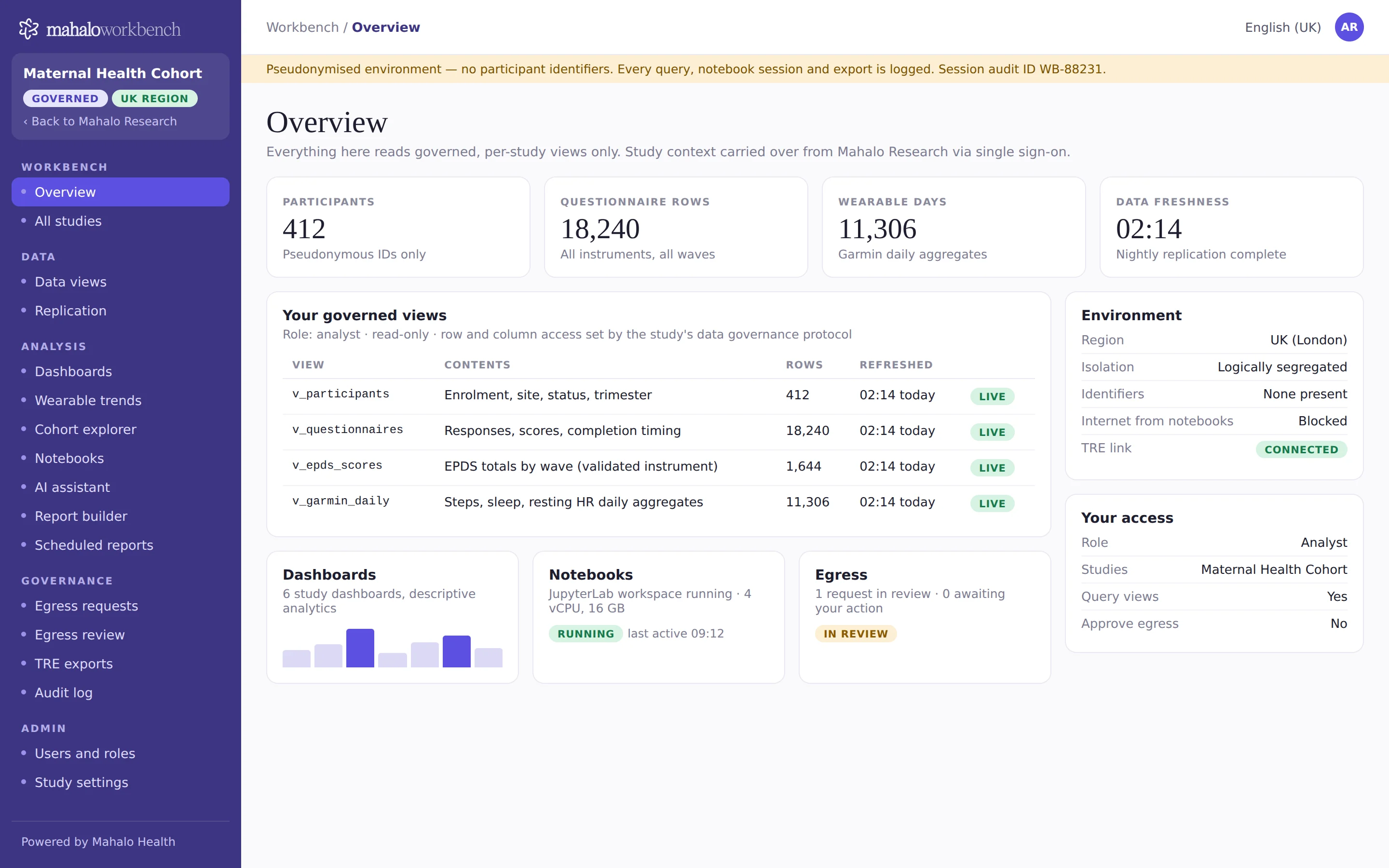
Workbench is a secure analysis environment built into Mahalo Research. Dashboards for every researcher, notebooks for your analysts, plain-language answers for everyone — and nothing leaves without review. The export habit ends here.
01 · The problem
The export is where governance ends.
Modern studies capture data under consent, audit and access control — then export it to analyze it. Every CSV on a laptop is an ungoverned copy: unversioned, unauditable, stale by morning. Workbench brings analysis to the data instead, so findings carry the same chain of custody as the record they came from.
02 · Governed views
One source of truth, with a paper trail.
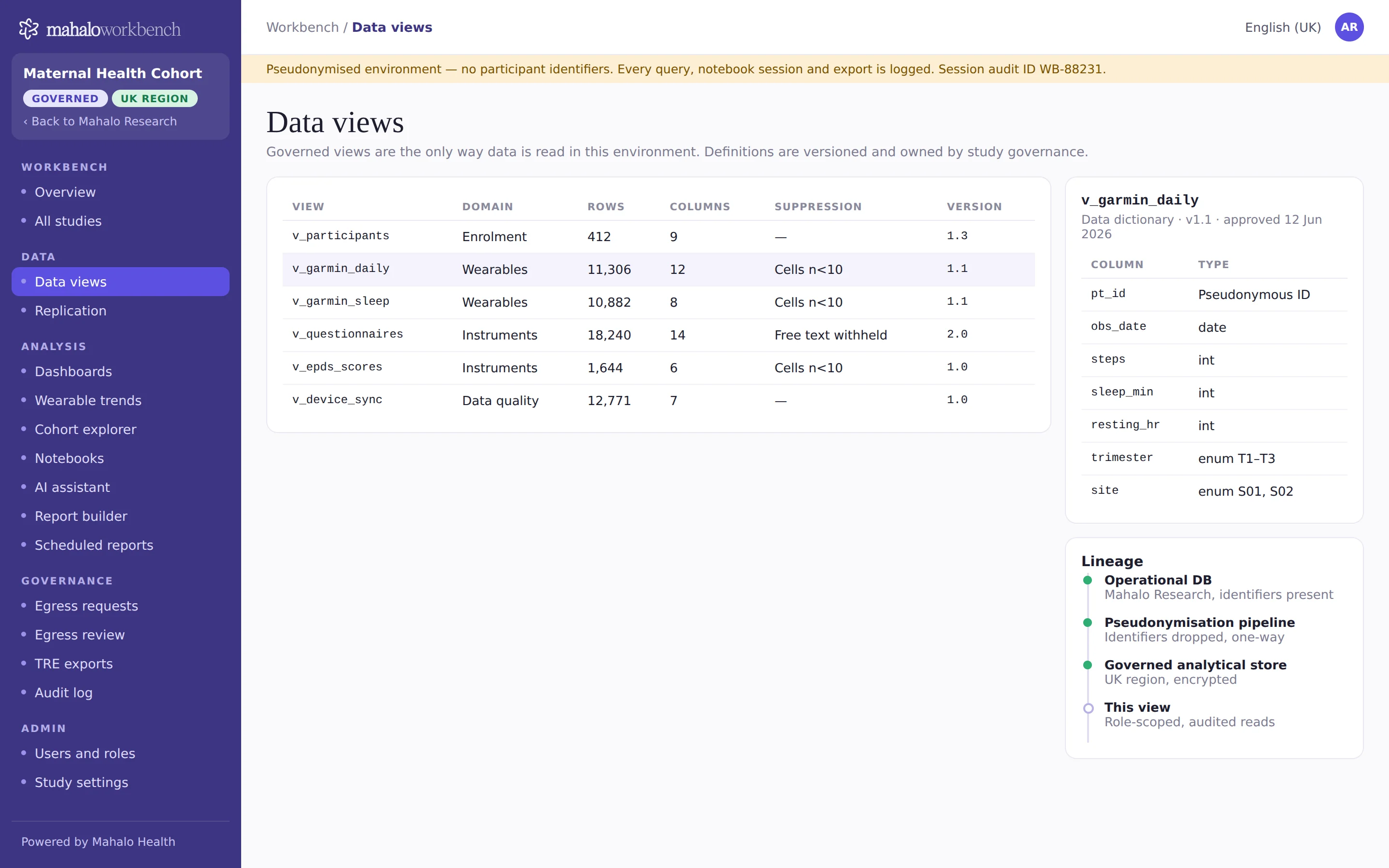
All analysis reads named, versioned, approved views — never raw tables. Each view publishes its data dictionary and its lineage: operational record, pseudonymisation, governed store, view. Role-based row and column access resolves at query time, and any aggregate below the study's threshold renders as "<10", everywhere, automatically.
- Versioned view definitions, released like software
- Lineage visible on every view
- Small-cell suppression enforced in the product
03 · Dashboards & cohorts
Answers without code.
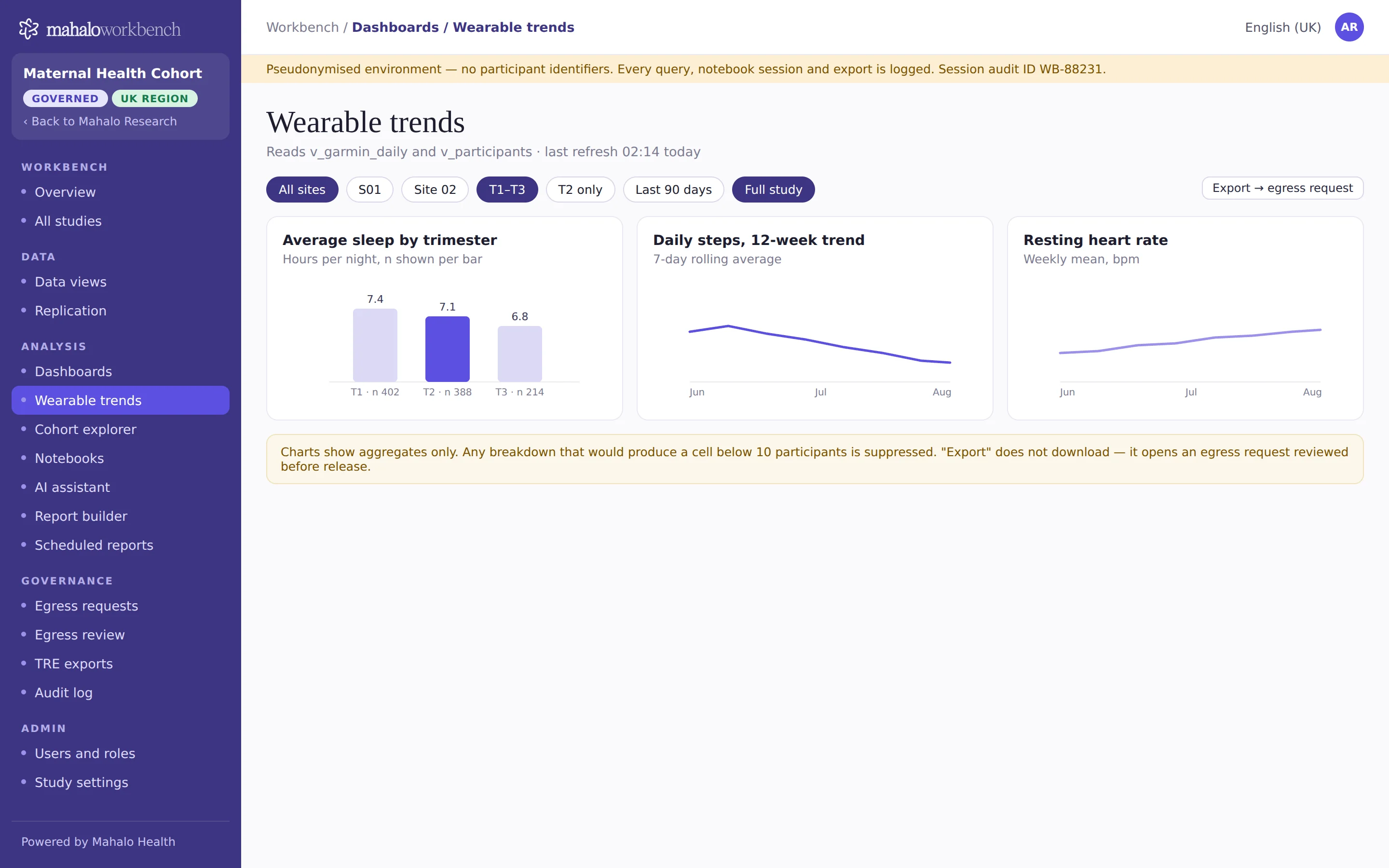
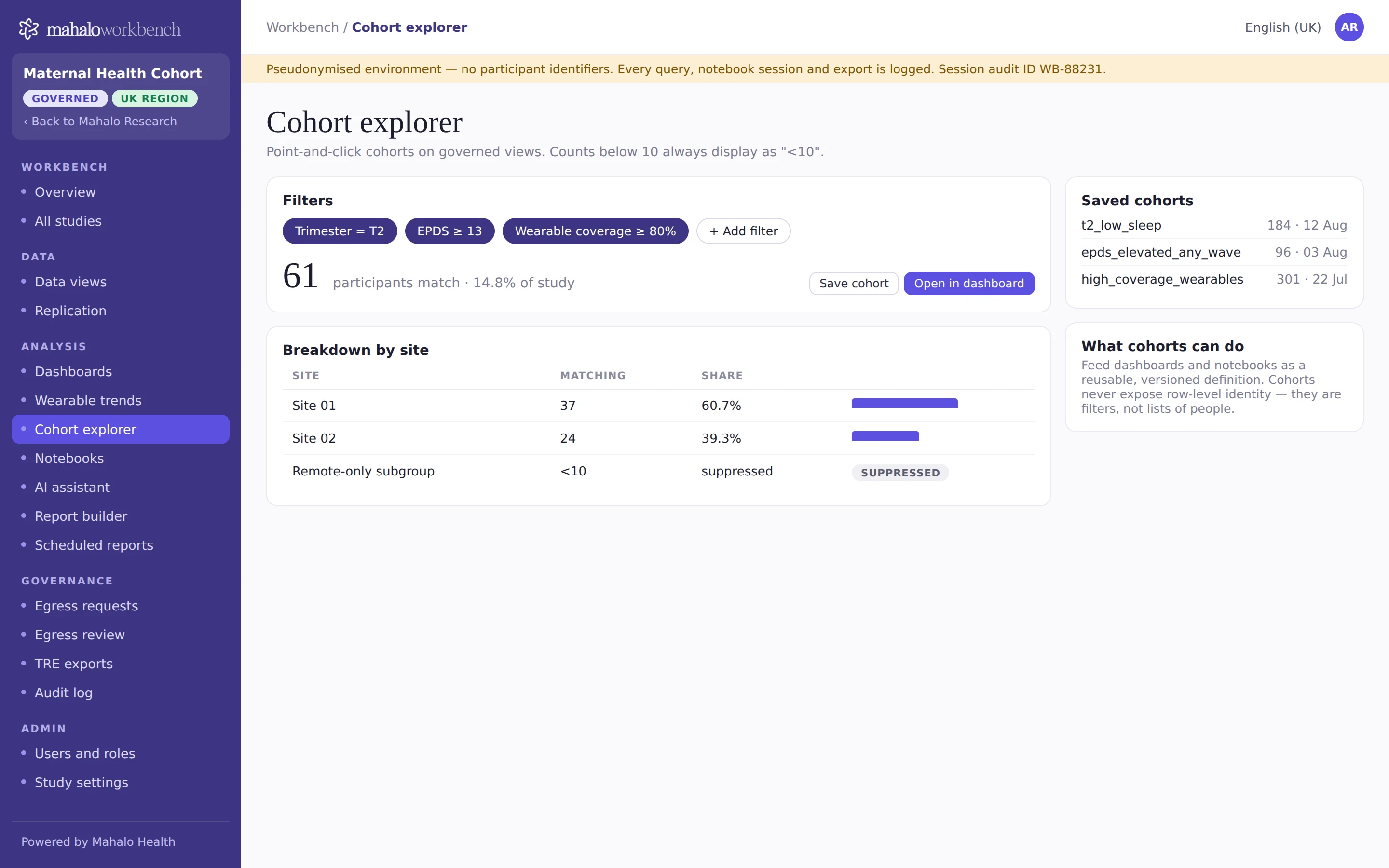
Researchers and clinicians explore the study in dashboards and a point-and-click cohort explorer — recruitment, retention, completion, data quality, questionnaire scores, wearable trends. Cohorts are saved as versioned filter definitions, not lists of people. There is no download button; the export action opens an egress request.
- Operational and scientific dashboards on live views
- Cohort counts that respect suppression
- Filters recompute live, per site, wave or period
04 · Analyst workspaces
Real tools for your analysts.
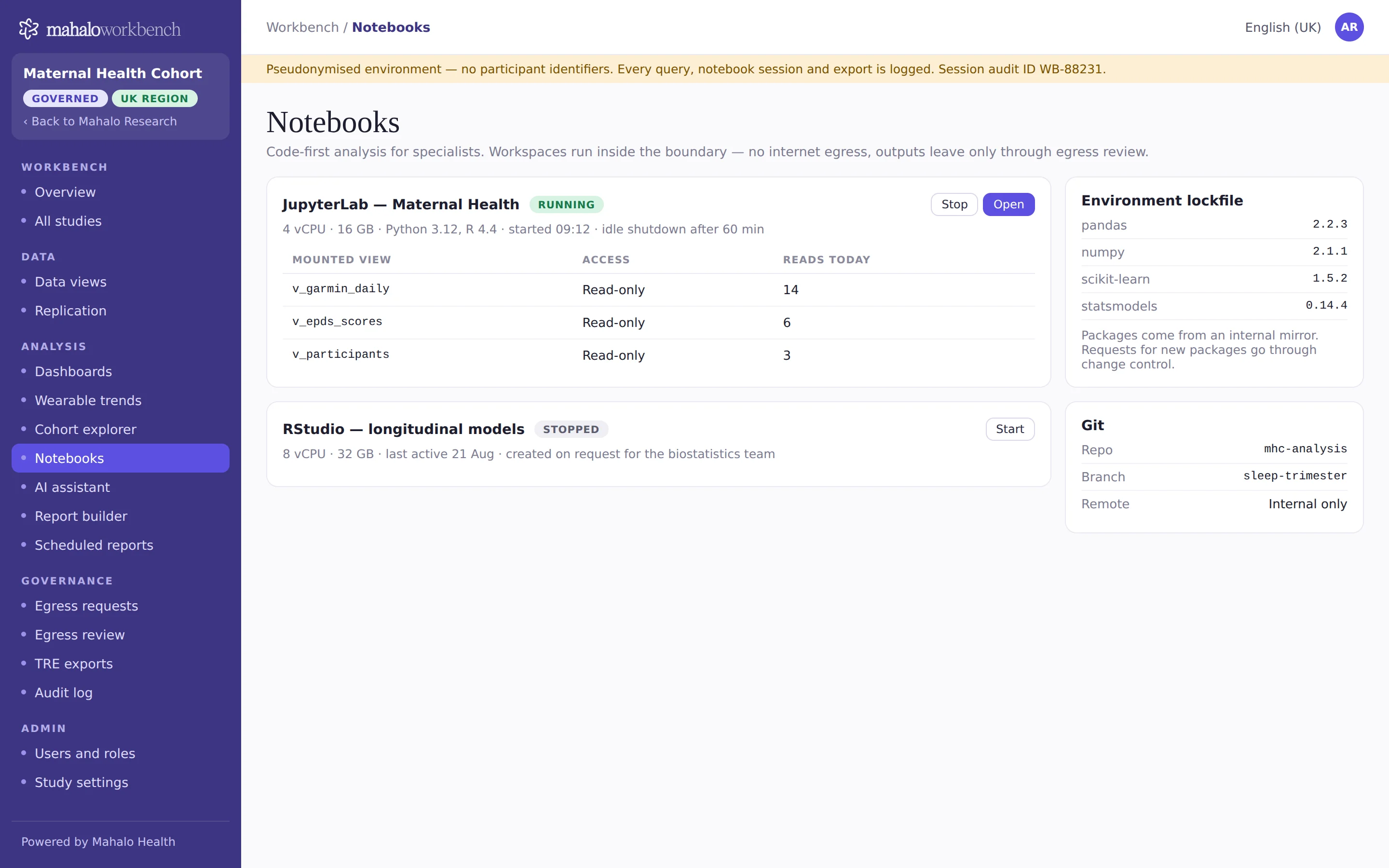
JupyterLab and R workspaces run inside the boundary with views mounted read-only, packages pinned from an internal mirror, and internal git. Regression, longitudinal models, signal processing and machine learning happen on live governed data — not on last month's extract. Workspaces have no general internet egress, because an open outbound connection is an unreviewed exit.
- Per-study workspaces, right-sized compute
- Pinned environments, reproducible by design
- Outputs leave only through egress review
05 · Governed answers
Ask in plain language. Verify in one click.
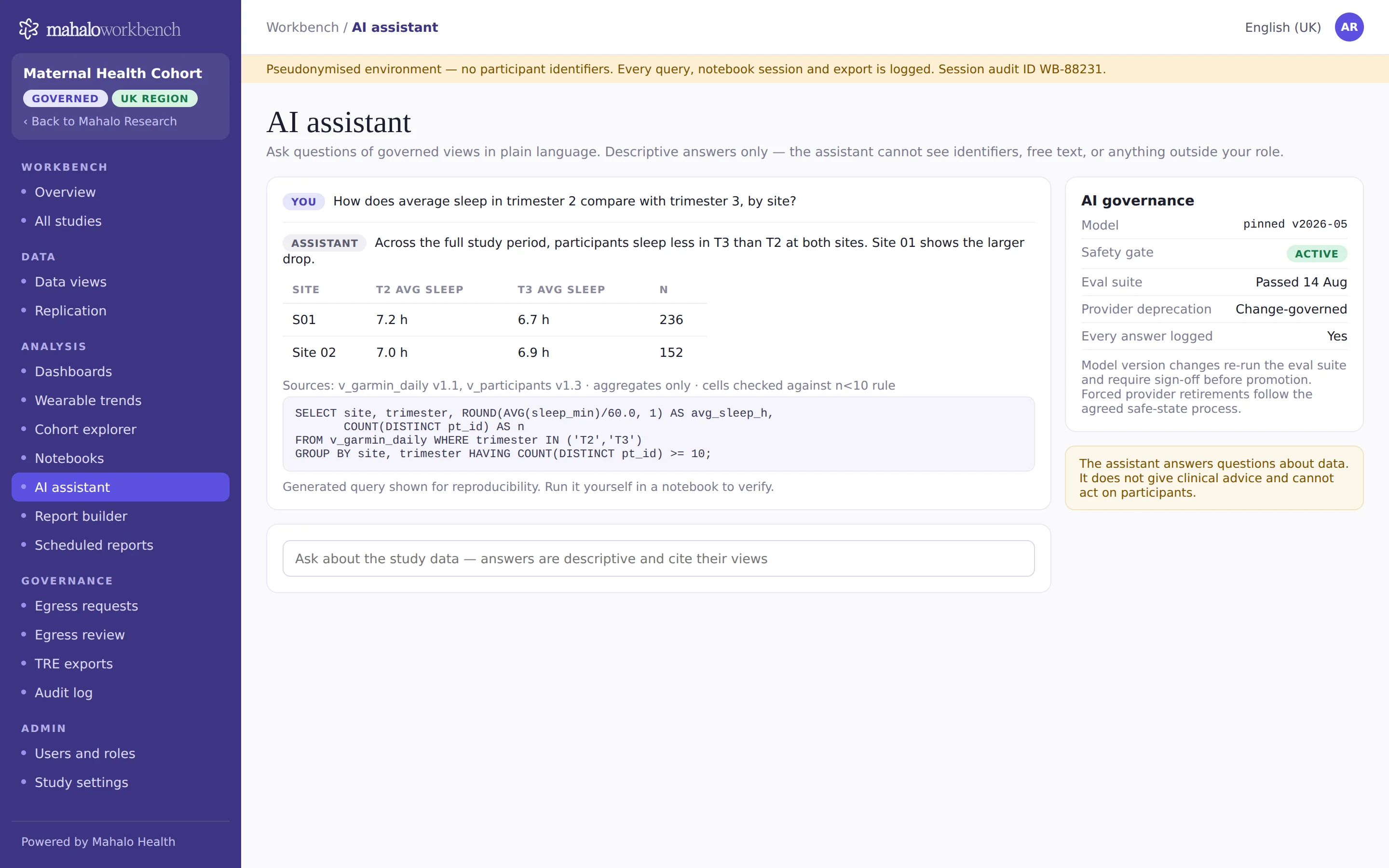
The Workbench assistant answers questions about study data with the sources named: every answer cites the views and versions it read and shows the generated query, so a statistician can reproduce it in a notebook. It sees only what the asker may see, applies suppression to its answers, and runs on a pinned, change-governed model version. Every interaction is logged.
- Answers cite views and versions
- Generated query shown for reproducibility
- Descriptive answers only — never clinical advice
06 · Reviewed egress
Nothing leaves unreviewed.
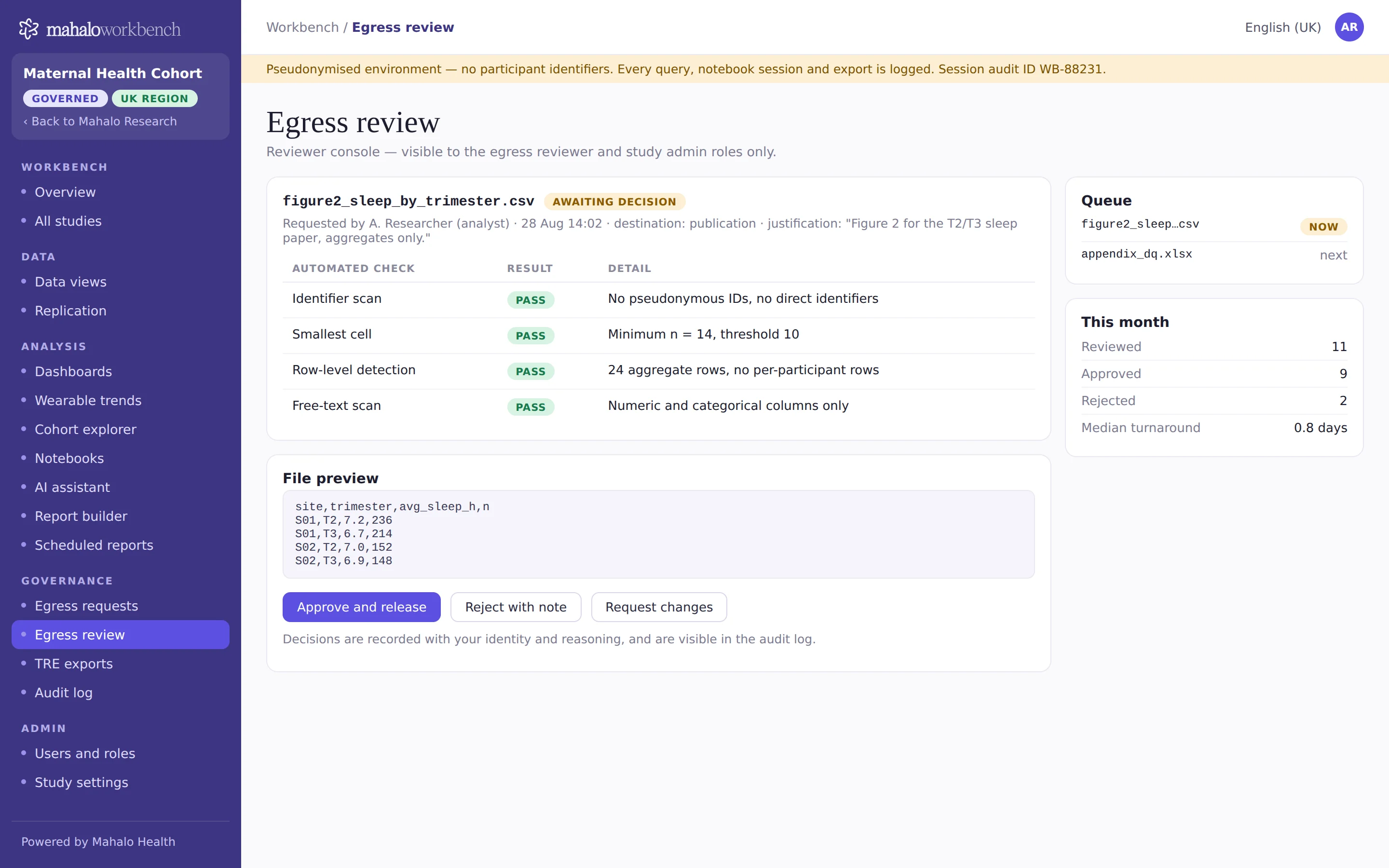
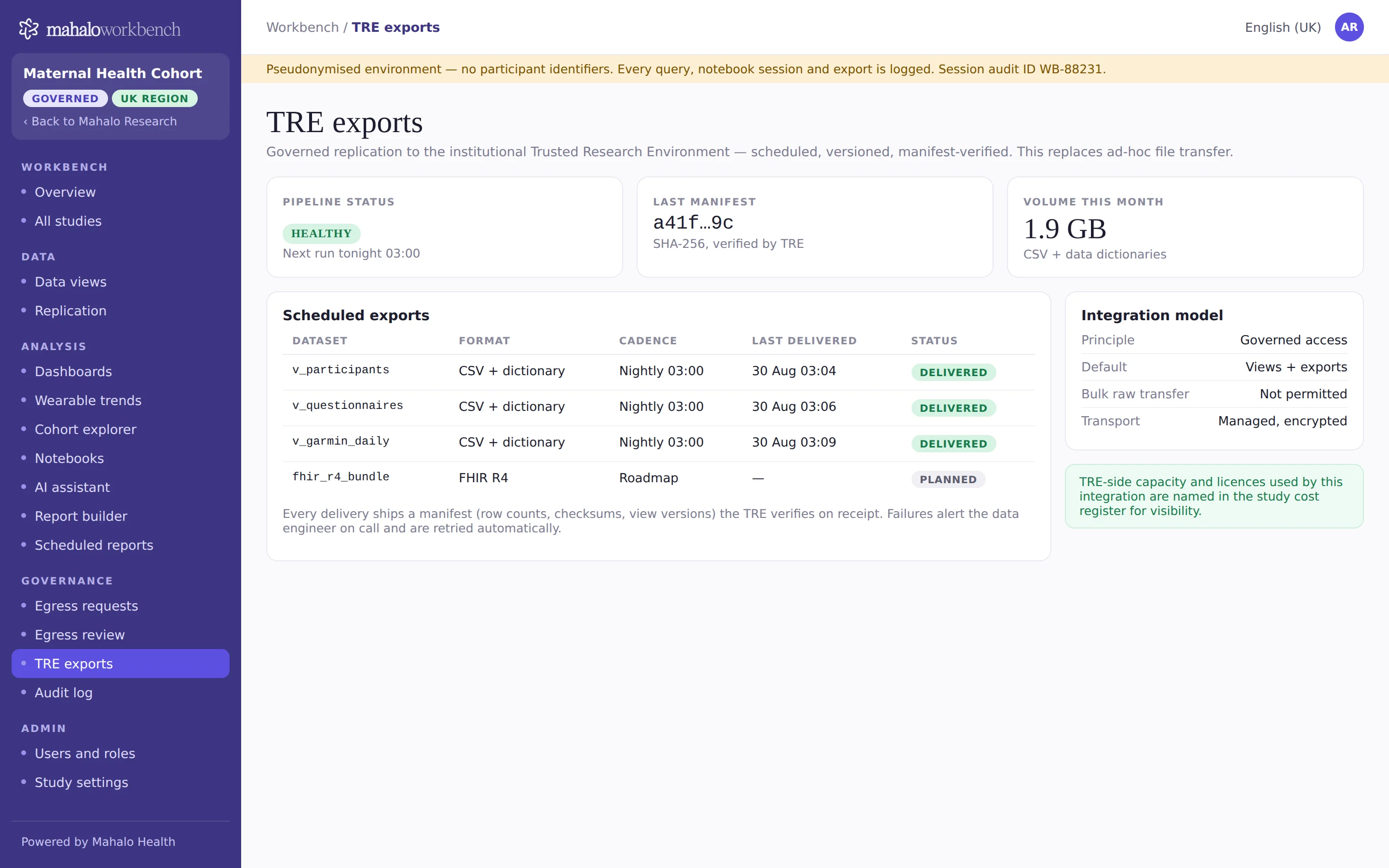
There are two exits. Analysts request egress; automated checks — identifier scan, row-level detection, smallest-cell computation — run first, then a reviewer approves release to a named destination with an expiring link. Scheduled deliveries ship governed views to institutional trusted research environments with manifests the receiving side verifies. Rejections travel back with the reviewer's note, so the control teaches instead of just refusing.
- Automated checks before human review
- Separation of duties: producers can't approve
- Every decision an audit record
07 · Reproducible reporting
Findings that stay reproducible.
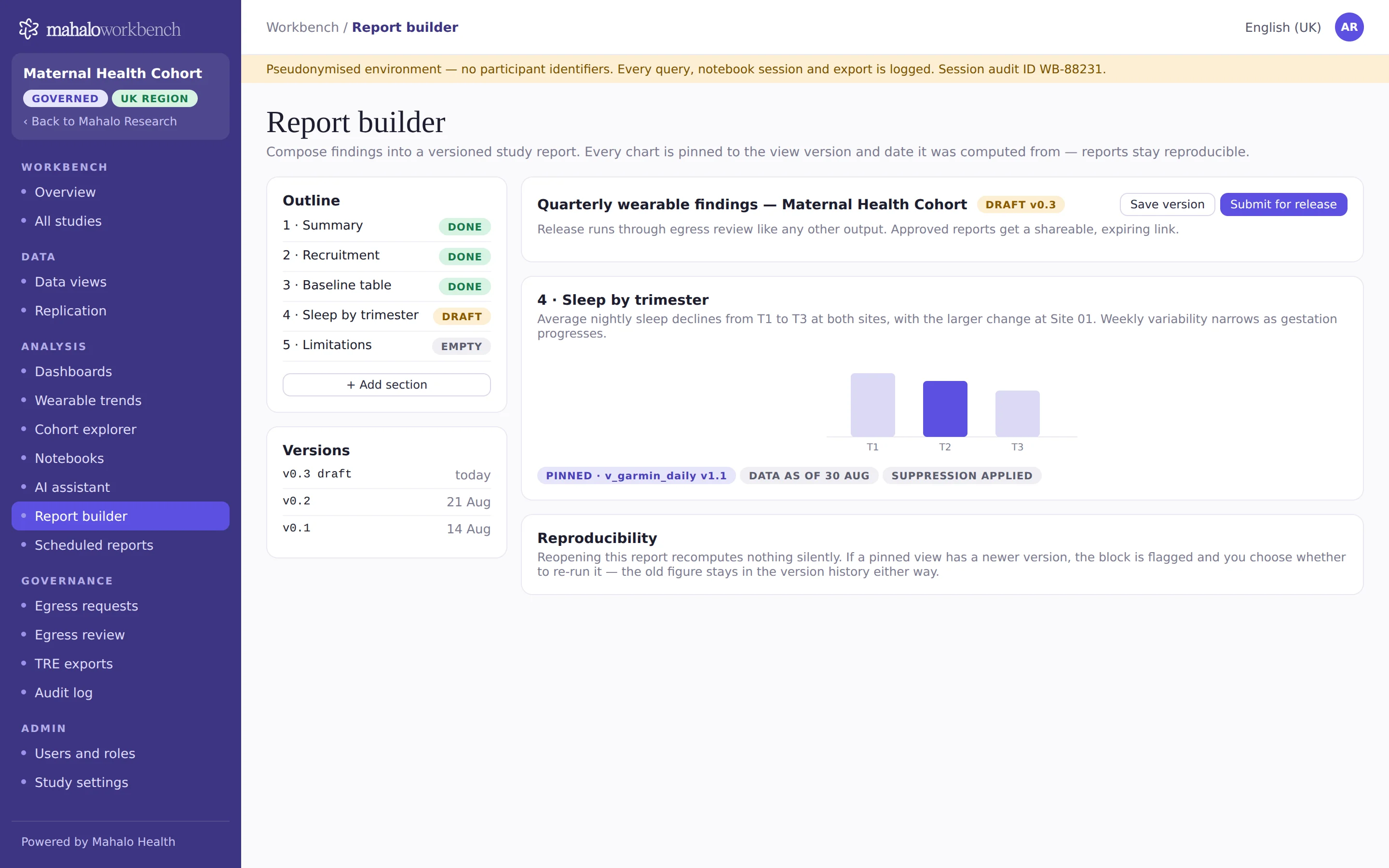
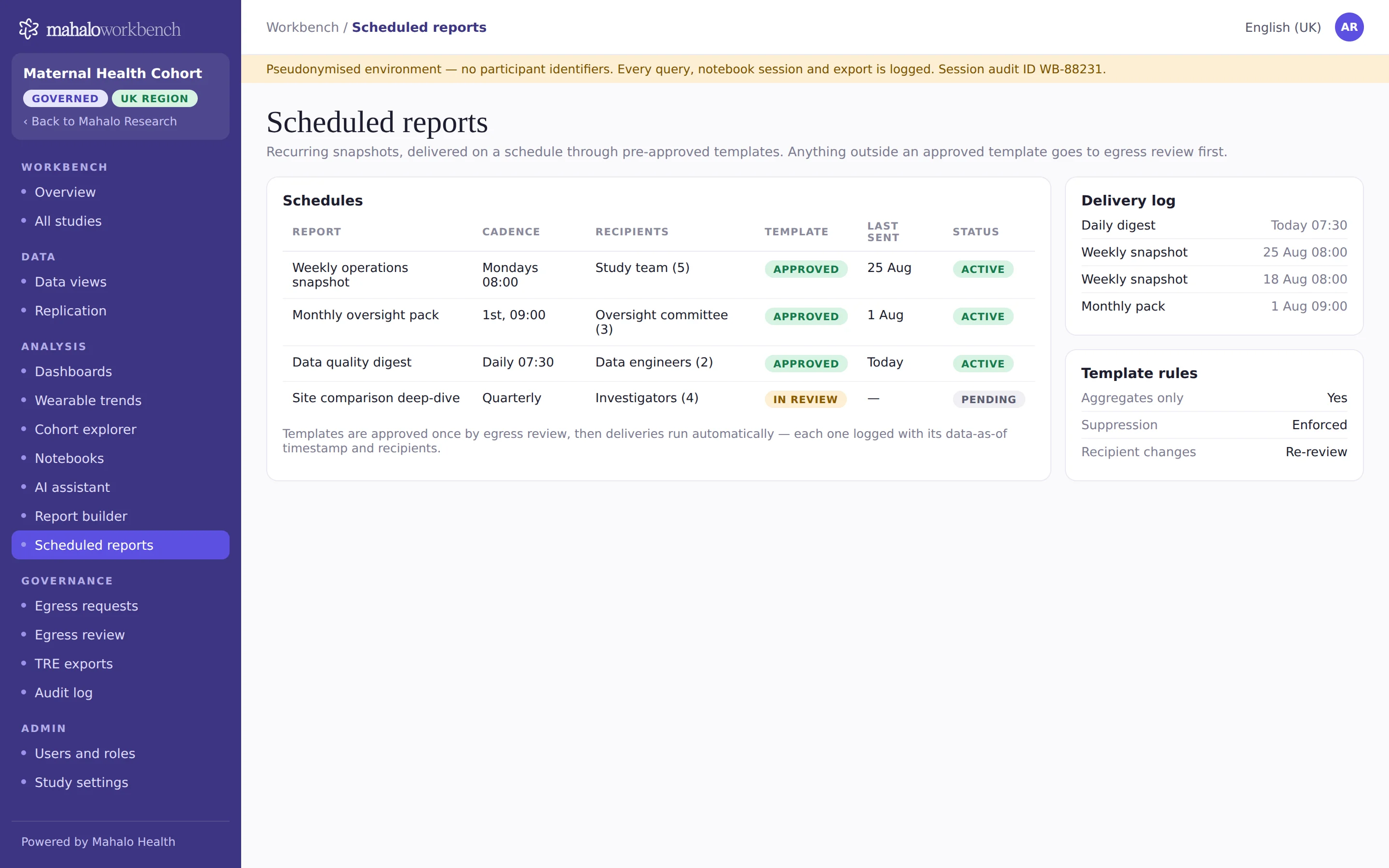
The report builder pins every chart to the view version and as-of date it was computed from; reopening a report recomputes nothing silently. Scheduled reports deliver recurring snapshots through templates egress review approved once — each delivery logged with its data timestamp and recipients.
08 · Portfolio analysis
One workbench across your portfolio.
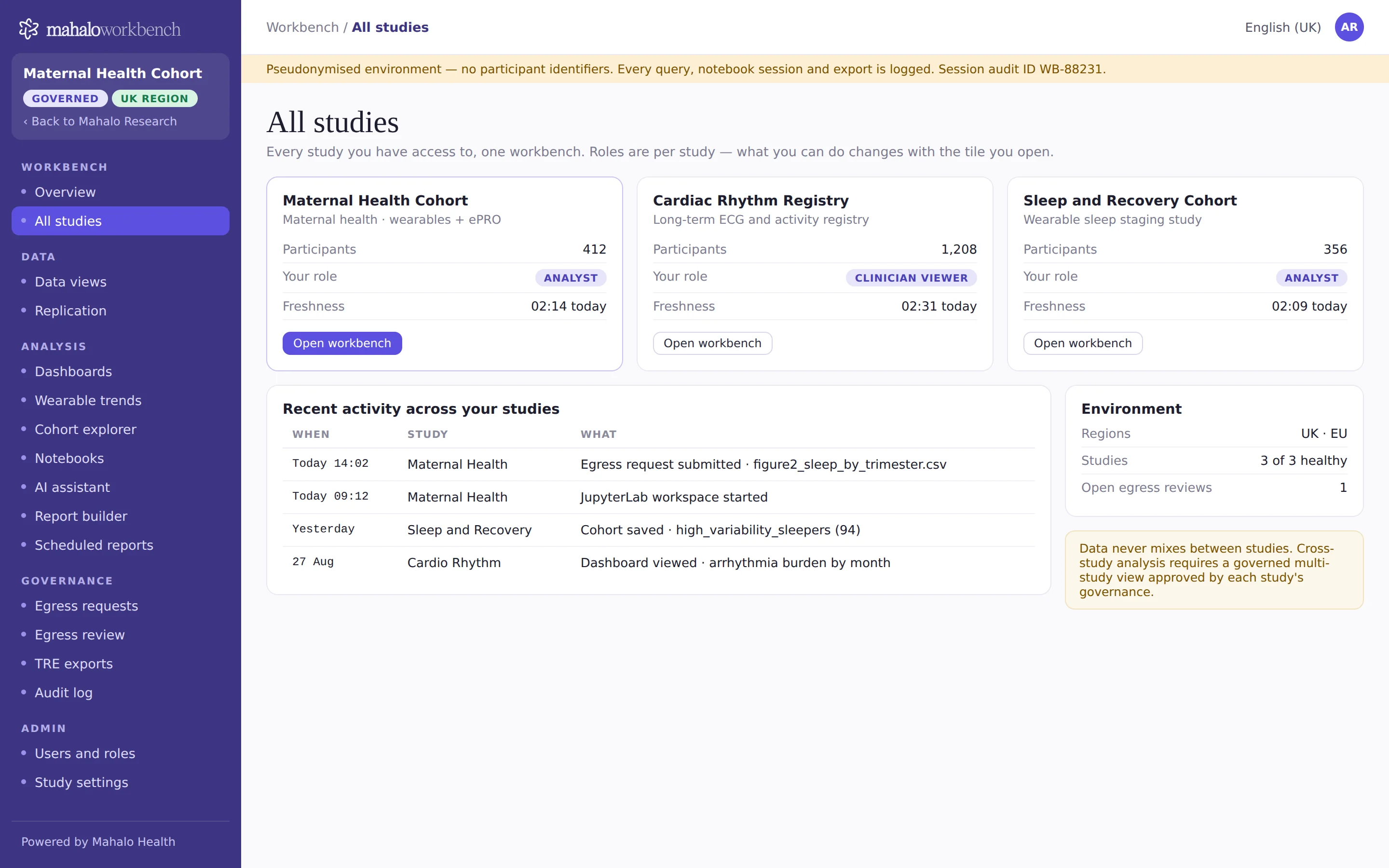
Every study you can access, one place — with your role resolved per study. Data never mixes between studies; cross-study analysis requires a governed multi-study view approved by each study's governance. Deployed in-region where residency law requires it.

Whitepaper
Analysis without the export
Featured whitepaper
Analysis without the export
Why study-data governance breaks at analysis — and how governed views, notebooks, AI answers, and reviewed egress close the gap.
Get the whitepaperWorkbench inherits the platform's audit, access and security model — review it in the Trust Center.
See your study in Workbench.
Bring one study — its questionnaires, its wearables, its team — and we'll walk it through the workbench end to end: views, dashboards, a notebook, and an egress request.
Frequently asked questions
What is Mahalo Workbench?
Is Workbench a trusted research environment (TRE)?
Who can see identifiable participant data in Workbench?
Do analysts need to write code?
How does data get out of Workbench?
Linking a biomarker to an outcome in an aging cohort? See how Workbench supports healthy longevity research.