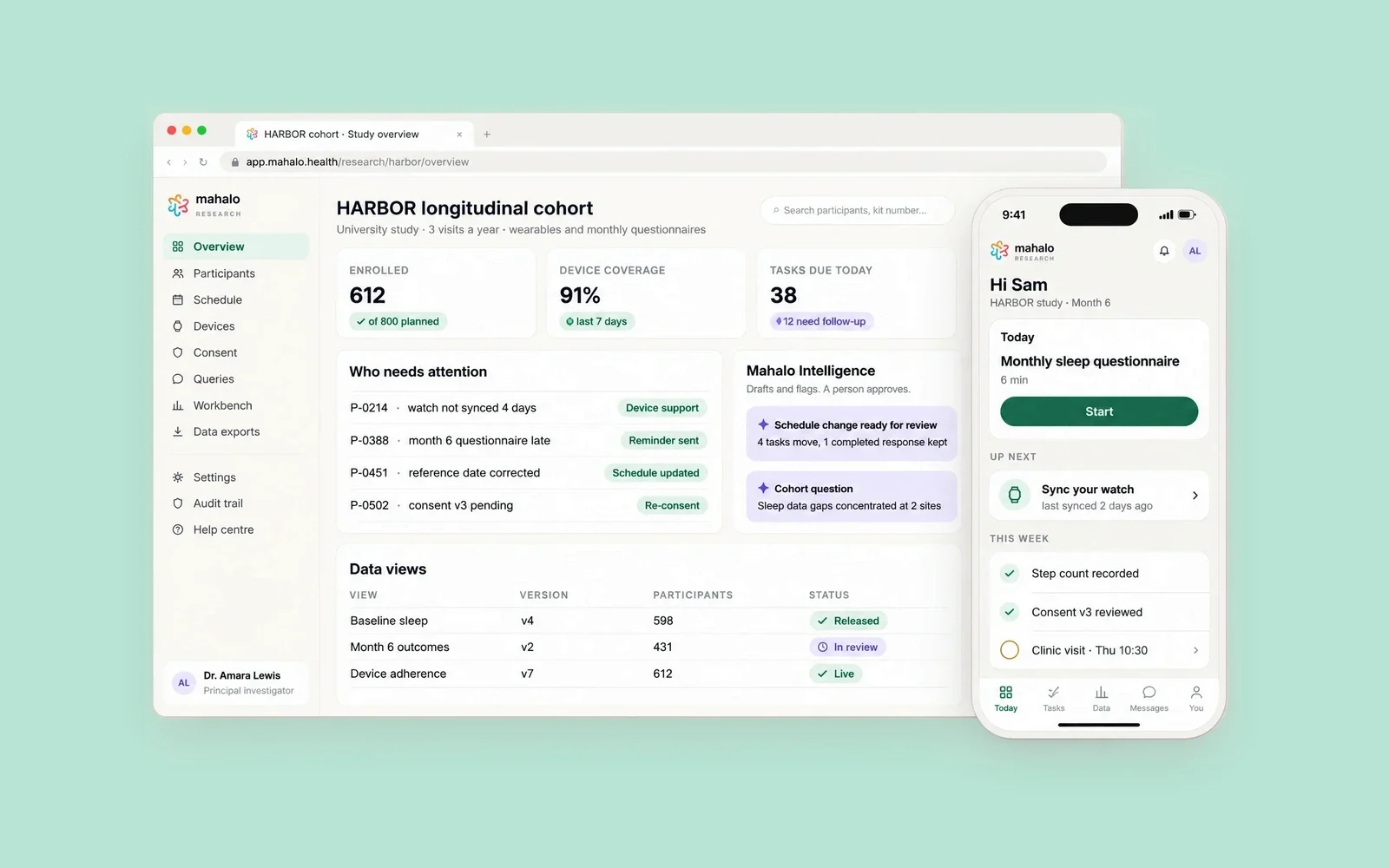
Mahalo Health publishes this guide and Recruit, our product, is one of the options in it. We built it in November 2026 from each vendor's public product pages, press releases and Epic Showroom listings. We did not run hands-on tests of other vendors' software. The comparisons are our opinion.
Key takeaways
- EHR-integrated recruitment software reads patient records at a site or health system, checks them against a protocol's inclusion and exclusion criteria, and gives a research team a list of people who may qualify.
- The tools differ most in four places: which EHRs they read and how, whether they read doctors' notes or only structured fields, who reviews each match, and what happens after a match (outreach, referral, feasibility).
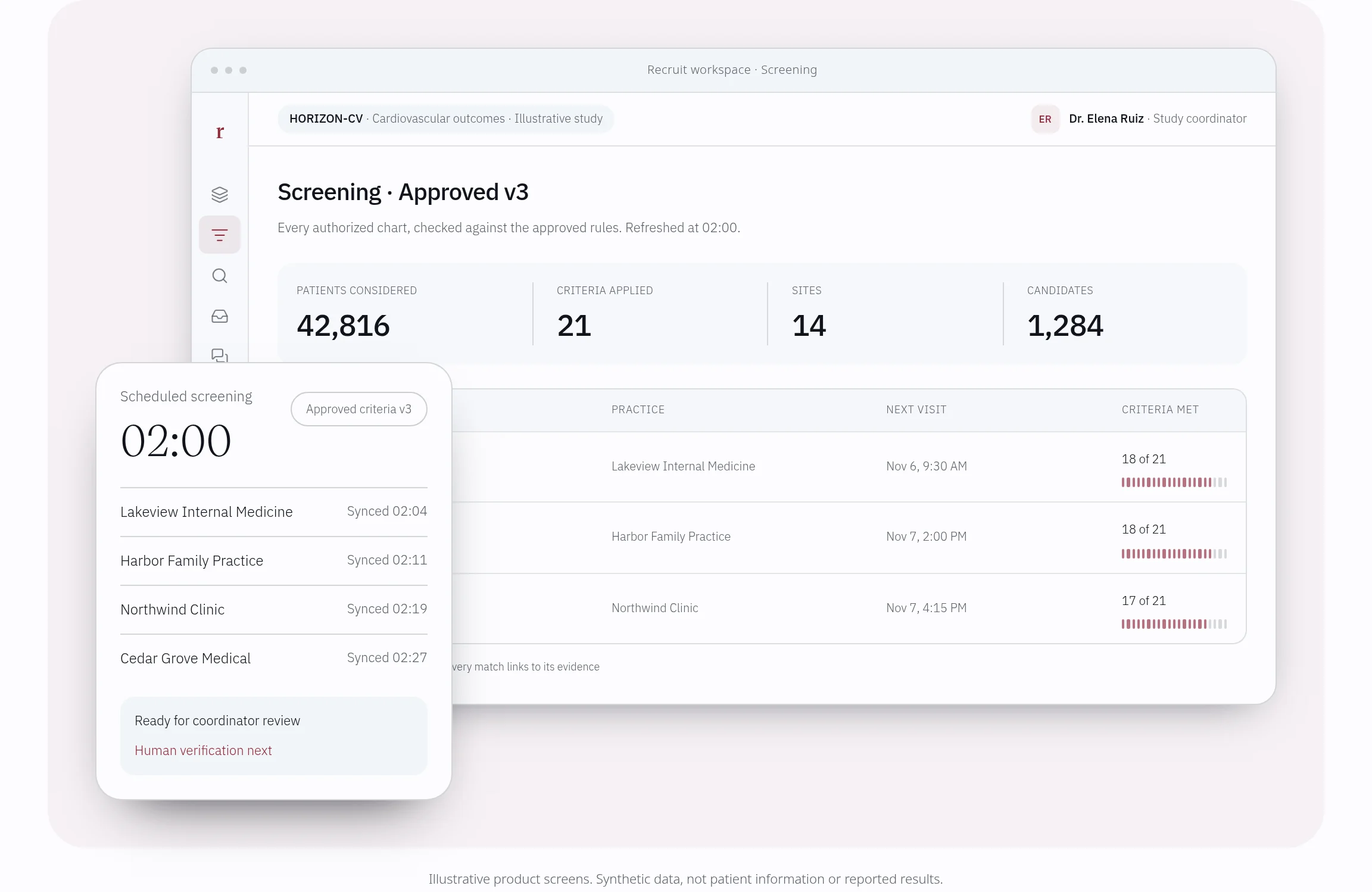
- Recruit by Mahalo Health screens authorized charts nightly, shows the evidence for every match, has a named person verify each one, and hands verified candidates to outreach and to CRIO or a CTMS.
- Network tools such as TriNetX and BEKhealth suit feasibility and site selection. Oncology teams should compare Triomics and Tempus. HealthKey sells on a success-fee model with Epic integration. Bond Health pairs EHR screening with paid ads and AI voice agents.
The short answer
Pick by where your patients are and who does the work. If your sites run more than one EHR and you want a coordinator to see why each person may fit before anyone is contacted, choose Recruit by Mahalo Health. If you need feasibility counts across a large network before you pick sites, look at TriNetX or BEKhealth. For oncology programmes inside cancer centres, compare Triomics and Tempus. If you want EHR matching with no upfront fee, look at HealthKey. If you want EHR screening combined with ad-driven patient acquisition, look at Bond Health.
What EHR-integrated recruitment software does
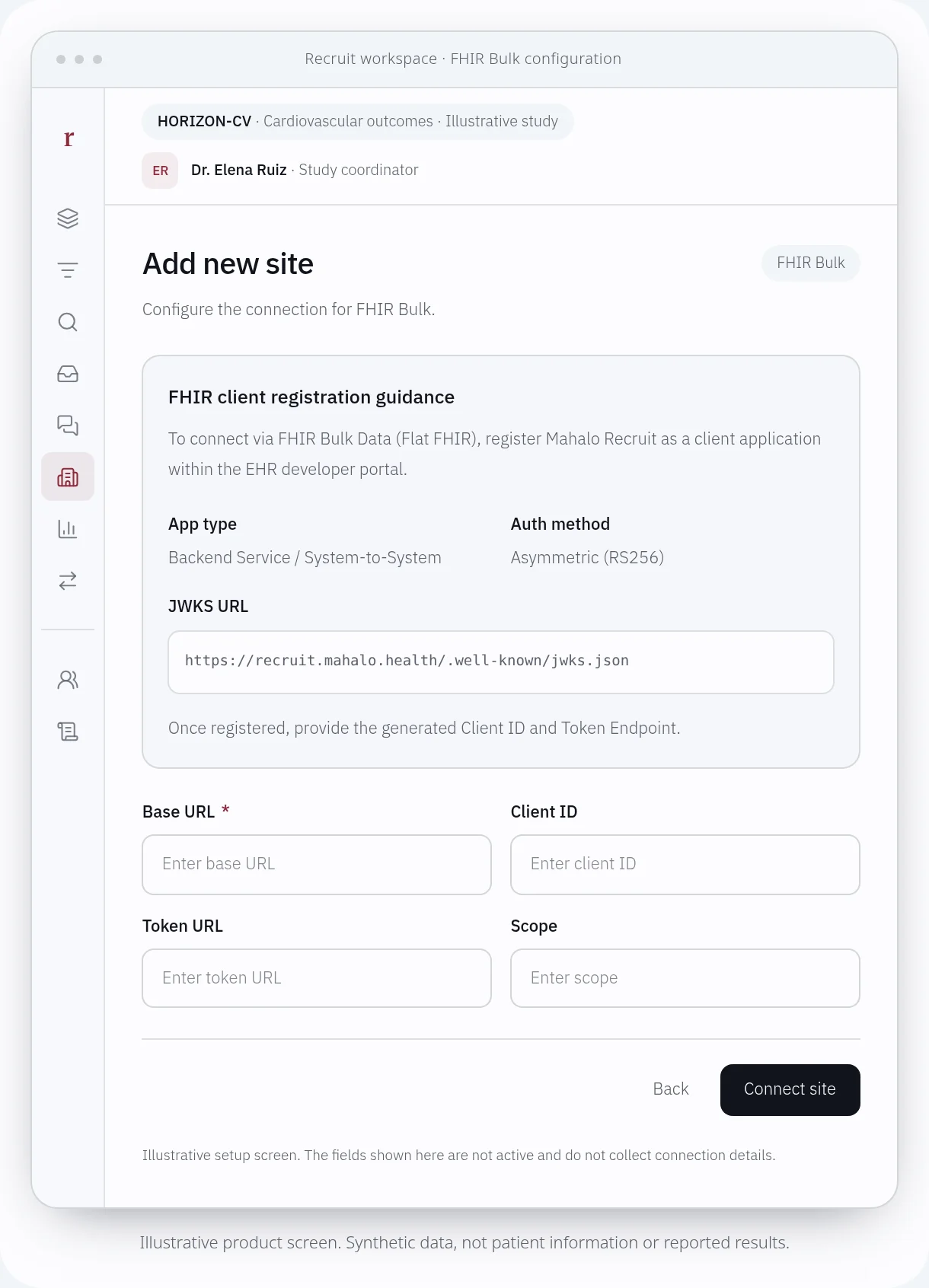
Most of these tools connect through FHIR APIs that the EHR vendor publishes, sometimes with a bulk export that pulls a defined patient population in one job. Epic publishes its APIs at fhir.epic.com, Oracle Health documents Bulk Data Access for Millennium, and athenahealth documents a FHIR R4 group export. Others integrate through a health system's data warehouse or an EHR app marketplace.
Structured data (diagnoses, labs, medications) answers many criteria. A large share of eligibility still sits in free-text notes: disease stage, symptom severity, prior treatment response. Tools that read notes find more candidates, and they also need a clear way to show a reviewer where each answer came from.
How to evaluate the options
- EHR coverage. List the EHRs at every site in your network, then ask each vendor how it connects to each one and who signs what at the practice.
- Notes, not just fields. Ask whether the tool reads physician notes and reports, and whether a coordinator can open the exact excerpt behind a result.
- Evidence and review. Ask who confirms each match before a patient is contacted, and what the tool does when the chart cannot answer a rule.
- What leaves the practice. Ask what data moves to the sponsor or CRO, and whether the practice can give or withdraw permission per study.
- After the match. Ask how candidates are contacted and how referrals reach your CTMS or eSource.
- Pricing model. Some vendors charge per site or per study, some per enrolled patient. Get the model in writing before you compare costs.
The best EHR-integrated clinical trial recruitment software in 2026
Recruit by Mahalo Health: evidence for every match, verified by a person
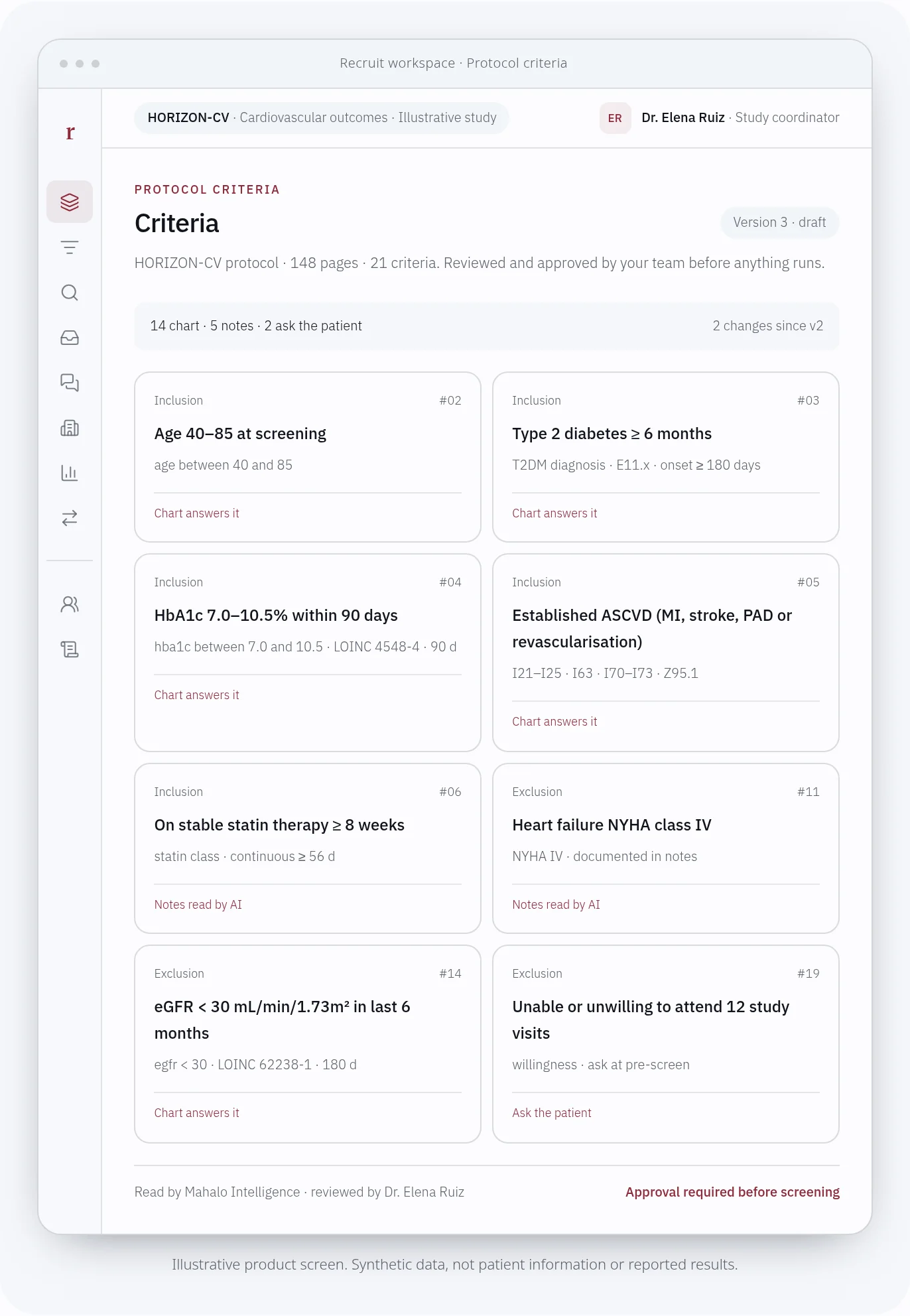
Recruit is the patient recruitment product in Mahalo Research. Mahalo Intelligence reads the protocol and drafts each inclusion and exclusion rule; your team approves the rules before anything runs. Each night Recruit screens the charts that practices have authorized for the study and gives the coordinator a shortlist with the evidence for every match: the lab value, the diagnosis, or the sentence from a doctor's note. A named person verifies every match.
- EHRs: connects through direct FHIR, including FHIR Bulk, and through our EHR connection network to Epic, Oracle Cerner, athenahealth, eClinicalWorks, NextGen, ModMed, Veradigm, Greenway and MEDENT. See how it works for Epic, Oracle Cerner and athenahealth.
- Unknowns: when a chart cannot answer a rule, Recruit says so and turns it into a pre-screen question for the patient instead of guessing.
- Permission: each practice gives permission per study, with a named signer, and can withdraw it.
- After the match: Noa, Recruit's outreach assistant, can invite verified candidates by text, email or voice in English, Spanish, French, German and Italian, and a person can step in at any point. Referrals go to CRIO or your CTMS with the eligibility summary attached.
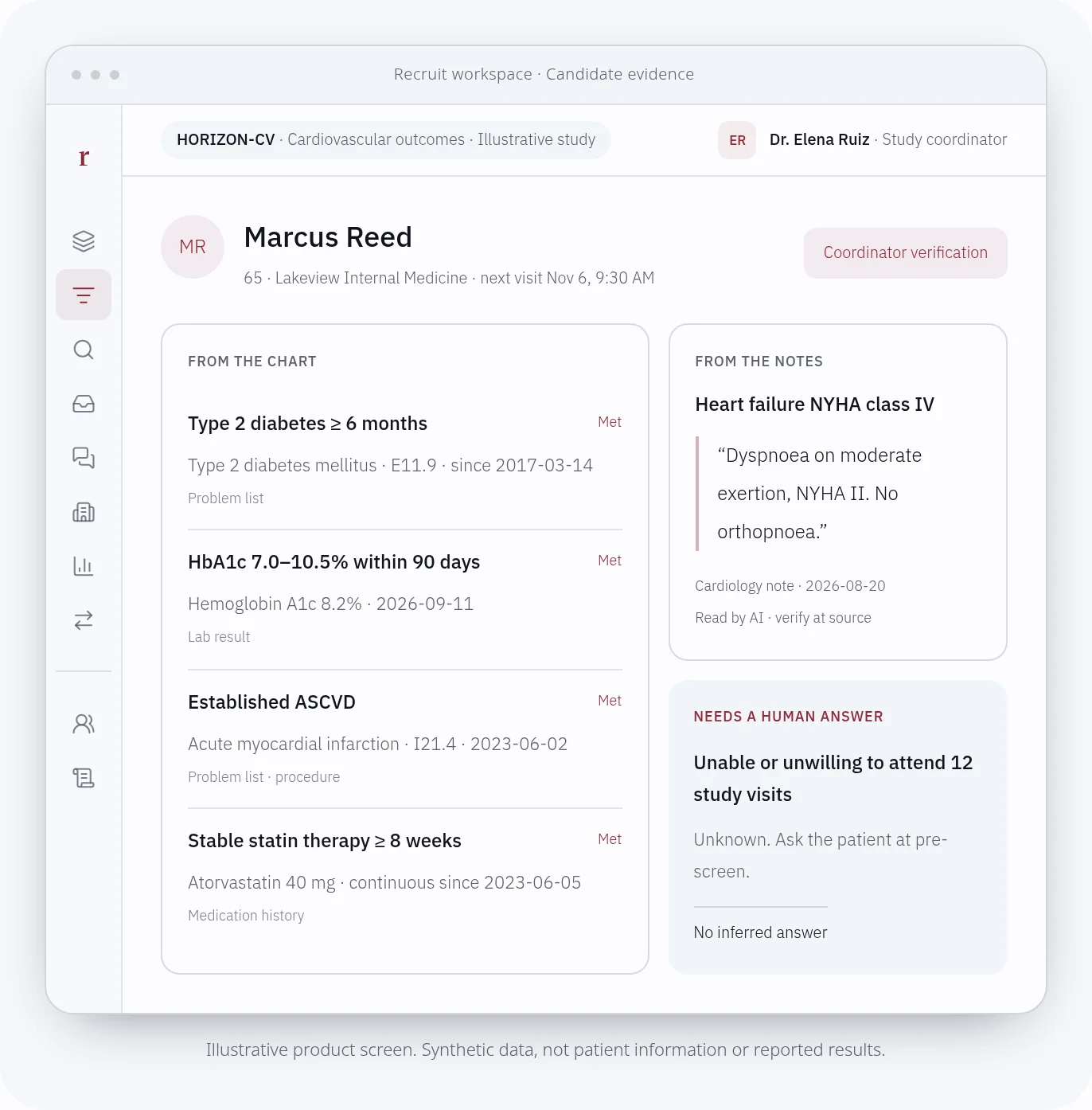
Best for: sponsors, CROs and site networks whose sites run several EHRs, and teams that want coordinators to review evidence before any patient is contacted.
Limitations: Recruit screens charts at practices that join a study, so it does not offer a national de-identified network for feasibility counts. Each EHR connection needs an agreement and admin registration at the practice.
Tempus (Deep 6 AI): health system network inside a precision medicine company
Tempus acquired Deep 6 AI in March 2025. At the time, Tempus said Deep 6 AI's software was integrated with over 750 provider site locations spanning more than 30 million patients, and that it mines structured and unstructured EMR data to find patients for trials (Tempus). Tempus runs its own trial matching through its TIME network and Next Trials.
Best for: sponsors and health systems already working with Tempus, especially in oncology. Limitations: the product now sits inside a larger Tempus offering, so check what is sold on its own and what depends on Tempus programmes.
Triomics: oncology trial matching for cancer centres
Triomics reads every note, report and fax in the oncology record and matches each patient on the clinic schedule against every active trial daily, giving research staff a worklist with citations. It reports more than 65,000 patients screened for trials each month and more than ten NCI-designated cancer centre customers (Triomics).
Best for: cancer centres with many open oncology trials. Limitations: built for oncology; other therapeutic areas need another tool.
BEKhealth: research network for feasibility and site selection
BEKhealth reads structured and unstructured EHR data and reports 95%+ accuracy. It describes a network of more than 21 million patients across 200 research sites and over 1,000 trials, with a query and cohort builder and feasibility reports (BEKhealth).
Best for: sponsors and CROs planning feasibility and choosing sites within its network. Limitations: value depends on whether your target sites are already in the network.
HealthKey: Epic-integrated matching with success fees
HealthKey integrates with Epic and uses structured and unstructured data to find eligible patients, emailing research teams eligible patients daily with the evidence. It describes $0 upfront and fees charged per successful patient (HealthKey; Epic Showroom).
Best for: Epic sites that want to try EHR matching without an upfront cost. Limitations: check coverage if your network includes sites on other EHRs.
TriNetX: federated real-world data for feasibility
TriNetX runs a federated network of more than 309 million de-identified patients across more than 14,200 clinical sites, where patient-level data stays at the source (TriNetX data). TriNetX LIVE supports protocol design, feasibility and site selection (TriNetX LIVE).
Best for: testing criteria and counting eligible populations before you commit to a protocol or a site list. Limitations: built for feasibility and site selection; identifying and contacting individual patients happens at the site.
Bond Health: EHR screening plus patient acquisition
Bond Health combines LLM-based EHR screening with Meta and Google ads, and uses voice and text agents to book screening visits. It claims up to 3x faster enrollment and 90%+ matching accuracy (Bond Health).
Best for: studies that need patients from outside a site's own records. Limitations: ad-driven acquisition adds IRB review of ad materials and a separate budget.
Epic Showroom also lists recruitment apps such as Massive Bio, which focuses on oncology, and LooPT CTM, which works through Epic alerts and MyChart. They are worth a look if all your sites run Epic.
Side-by-side comparison
| Option | Best for | What it reads (vendor-stated) | After the match | Scale or model (vendor-stated) |
|---|---|---|---|---|
| Recruit by Mahalo Health | Multi-EHR site networks; evidence-first review | Authorized charts and notes via direct FHIR, FHIR Bulk and an EHR connection network | A named person verifies; Noa outreach; referral to CRIO or a CTMS | Nightly screening; permission per study |
| Tempus (Deep 6 AI) | Tempus partners, oncology | Structured and unstructured EMR data | Tempus trial programmes (TIME, Next Trials) | 750+ provider sites, 30M+ patients (March 2025) |
| Triomics | Cancer centres | Every oncology note, report and fax | Daily cited worklist for research staff | 65,000+ patients screened monthly |
| BEKhealth | Feasibility and site selection | Structured and unstructured EHR data | Cohort builder and feasibility reports | 21M+ patients, 200 research sites |
| HealthKey | Epic sites, no upfront fee | Structured and unstructured Epic data | Daily emails of eligible patients with evidence | Success fee per patient |
| TriNetX | Protocol design and feasibility | De-identified federated EHR data | Counts and site selection; contact happens at the site | 309M+ patients, 14,200+ sites |
| Bond Health | Patients beyond site records | LLM EHR screening plus ad leads | Voice and text agents book visits | Up to 3x faster enrollment (vendor claim) |
How to start without disrupting enrolling studies
- Pick one study that is behind on enrollment, and list the sites and EHRs involved.
- Ask each vendor to screen against your real criteria, and compare how many matches come with evidence a coordinator can check.
- Agree with each practice what data leaves it, who signs the agreement, and how permission is withdrawn.
- Decide how verified candidates reach your CTMS or eSource before the first patient is contacted.
For a deeper look at how Recruit connects to each EHR, read Recruit for Epic, Recruit for Oracle Cerner and Recruit for athenahealth.
See it on your own protocol
Bring a protocol and a site. We'll show you who matches, why, and what a connection to your EHR involves.
Sources
- Tempus, "Tempus Announces Acquisition of Deep 6 AI" (March 11, 2025): https://investors.tempus.com/news-releases/news-release-details/tempus-announces-acquisition-deep-6-ai
- Triomics: https://www.triomics.com/
- BEKhealth: https://www.bekhealth.com/
- HealthKey: https://gethealthkey.com/
- Epic Showroom, HealthKey listing: https://showroom.epic.com/Listing?id=3276&returnTitle=3
- TriNetX, data: https://trinetx.com/data/
- TriNetX LIVE: https://trinetx.com/solutions/trinetx-live/
- Bond Health: https://bondtrials.com/
- Epic Showroom: https://showroom.epic.com/
- Epic, FHIR APIs: https://fhir.epic.com/
- Oracle Health, Millennium Bulk Data Access: https://docs.oracle.com/en/industries/health/millennium-platform-apis/mfbda/bulk_data_access.html
- athenahealth, FHIR R4 group export: https://docs.mydata.athenahealth.com/fhir-r4/operation-group-export.html
- Recruit by Mahalo Health: https://mahalo.health/solutions/patient-recruitment