Key takeaways
- Most sponsors still run a trial on many separate systems: EDC, CTMS, eTMF, randomization, eCOA, eConsent, a recruitment vendor, a safety database, site payments and, if patients stay in care afterwards, a separate monitoring vendor.
- Medidata and Veeva have each pulled several of these into their own platforms. Neither replaces the whole stack, and neither runs care programs for the same patients after the study.
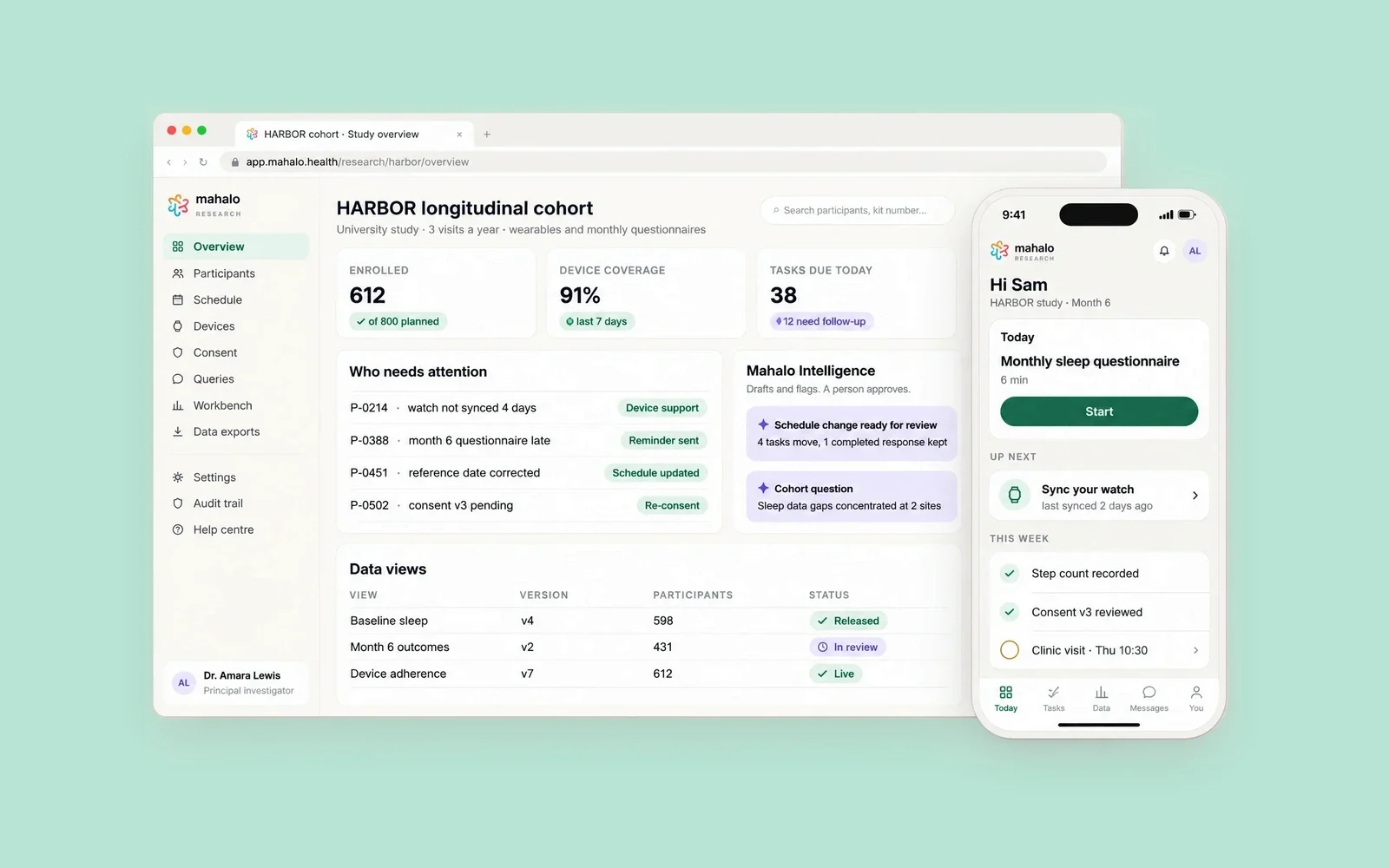
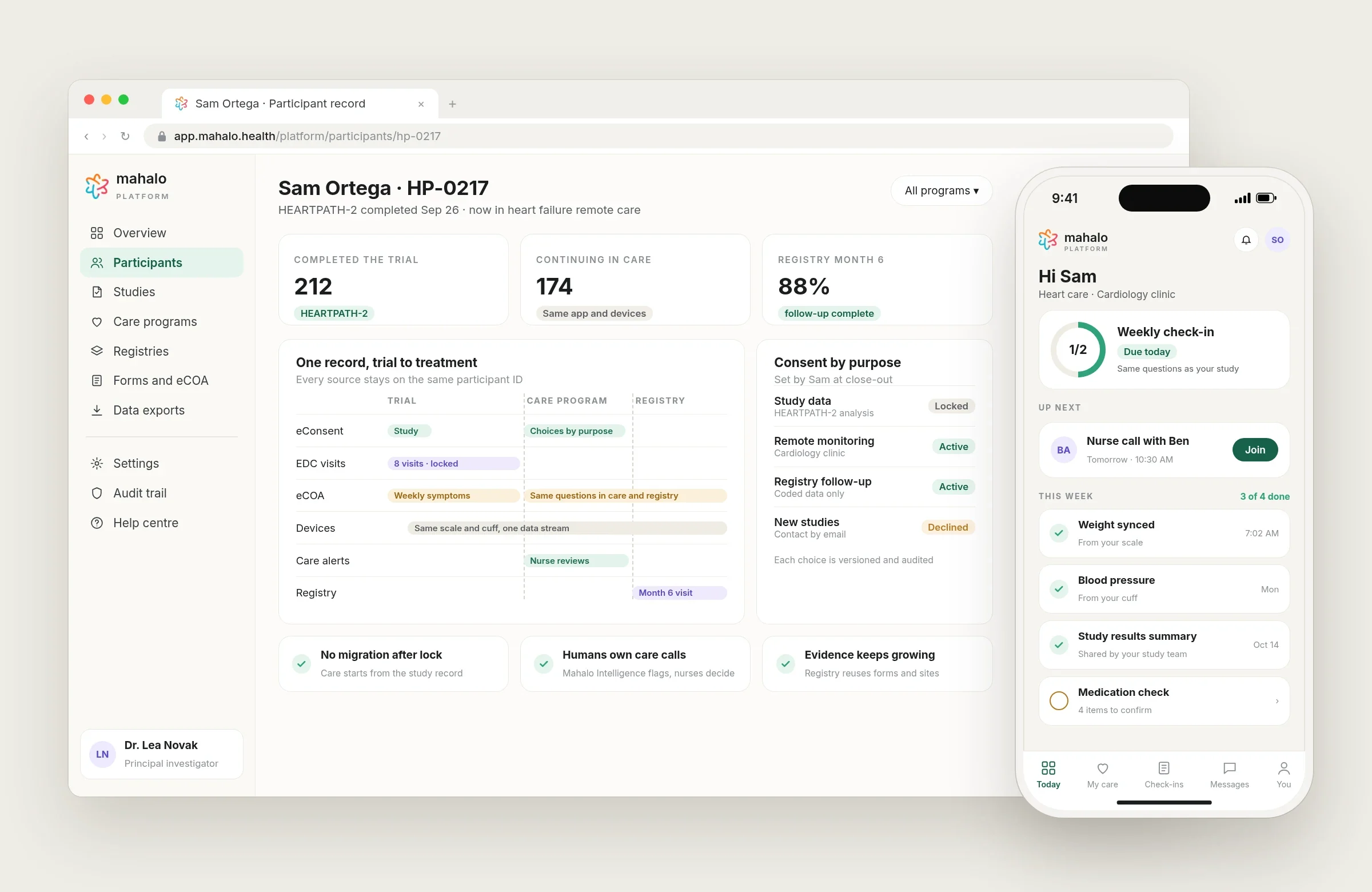
- Mahalo Health puts the clinical trial systems, AI patient recruitment from EHR records and connected care on one participant record, one study definition and one audit trail.
- Mahalo replaces nine systems outright, runs the workflow for three more with your partner, and connects to two it should never replace: the EHR and regulator portals.
- Medidata and Veeva remain strong choices for the largest global drug programmes, and Medidata especially where central imaging or endpoint adjudication sits at the centre of the study.
The short answer
If your study team spends its weeks making systems agree, the issue is architecture, not effort. A multi-vendor stack gives each system its own build, its own copy of the participant and its own audit trail. Medidata and Veeva shrink that problem inside their own product families. Mahalo Health removes it for most of the study by running the trial, recruitment and follow-up care on one record.
What a multi-vendor trial stack looks like in 2026
Here's what a typical interventional study runs on today:
- An EDC for case report forms
- A CTMS for sponsor oversight, and often a different one at each site
- An eTMF for the sponsor and an eISF or paper binder at the site
- An RTSM or IRT for randomization and trial supply
- An eCOA or ePRO app for participant questionnaires
- An eConsent tool
- A recruitment vendor, or coordinators reading charts by hand
- An EHR-to-EDC tool, or manual transcription from the chart
- A safety database
- A site payments tool
- Connected devices or a BYOD app
- A separate remote monitoring vendor if patients continue in care
Each system is built from the protocol separately, validated separately and amended separately. Each holds its own version of the participant. Data managers then reconcile those versions, query by query, until database lock.
The cost shows up in three places: build time before first patient in, amendment time during the study, and reconciliation time before lock.
Where Medidata and Veeva fit
Both vendors have answered the same problem by unifying their own products.
Medidata. Rave EDC is the centre of the Medidata Platform. Medidata says Rave aggregates and reconciles data from eConsent, eCOA, RTSM and imaging, and reports 1.8 million users and more than 38,000 studies on Rave EDC (Medidata).
Veeva. The Veeva Clinical Platform covers clinical operations (eTMF, CTMS, Payments, Study Startup, Site Connect, Study Training, Disclosures), clinical data (EDC and DQS), RTSM, eCOA, a free eISF for sites (SiteVault), single sign-on for researchers (VeevaID) and a patient app (MyVeeva for Patients) (Veeva). Veeva's own guidance describes one large biopharma retiring over 100 systems on the platform, and a global biotech whose primary implementation took one year after the discovery phase, with the first study live within six months (Veeva eBook).
So the industry agrees that consolidation is the direction. What's left outside both platforms is where sponsors still buy and reconcile separately:
- Finding patients in the EHR. Pre-screening charts at sites usually means a separate recruitment vendor or manual review.
- The site's own systems. Sites that work with several sponsors still juggle several platforms.
- Care after the study. Remote patient monitoring, chronic care and post-market follow-up run on different software, with a new record for the same person.
How Mahalo Health is built
Mahalo starts from one study definition, one participant record and one audit trail. Nothing downstream is configured by hand a second time, so there is no version of the study that quietly disagrees with another.
| What Mahalo does | Systems |
|---|---|
| Replaces outright (9) | EDC; CTMS for sponsor and site; eTMF and the site's own eISF; randomization and trial supply; eCOA and ePRO; eConsent; site eSource; site training records; randomization by phone |
| Runs the workflow, your partner keeps their system (3) | Central labs (the specification is generated from the schedule, results come in with units converted); site payments (calculated from verified visits and invoiced in Mahalo); enterprise pharmacovigilance (Mahalo holds the trial record and delivers the case file) |
| Connects to, never replaces (2) | Your EHR (it runs the chart; Mahalo reads from it where you approve); regulator and ethics portals (Mahalo tracks every submission and gates site activation on approval) |
On top of that foundation:
- Mahalo Intelligence reads the approved protocol and drafts the study build: forms, visits and edit checks. Your designer confirms each element before anything runs. When the protocol changes, it names the forms that change, the participants who must re-consent and the kits affected.
- Recruit screens authorized EHR charts nightly against the approved protocol rules and shows the evidence for every match. A named person verifies every match. Noa, Recruit's AI outreach agent, contacts candidates by text, email and voice and hands the conversation to a person when needed. Recruit connects to Epic, Oracle Cerner, athenahealth, eClinicalWorks, NextGen, ModMed, Veradigm, Greenway and MEDENT through an EHR connection network and direct FHIR.
- Mahalo Care runs remote patient monitoring, remote therapeutic monitoring, chronic care management, behavioral health integration and virtual care on the same record, so a participant can move from a study into a care program without starting over.
One study definition. One participant record.
Six screens follow one study from protocol to care. Drag to explore.
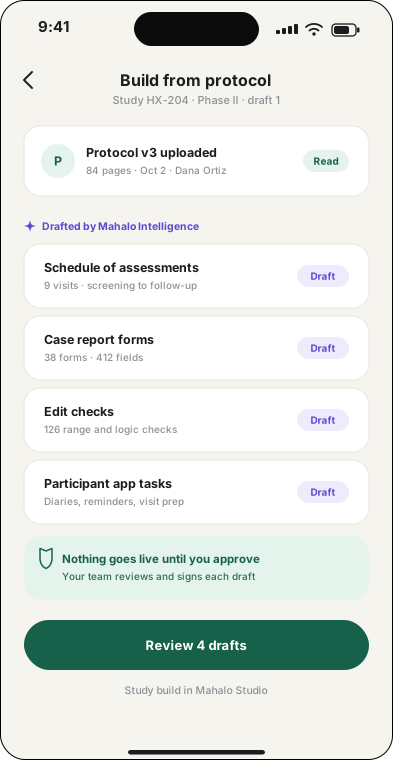
Build from protocol
Upload the protocol and Mahalo Intelligence drafts the study build for review.
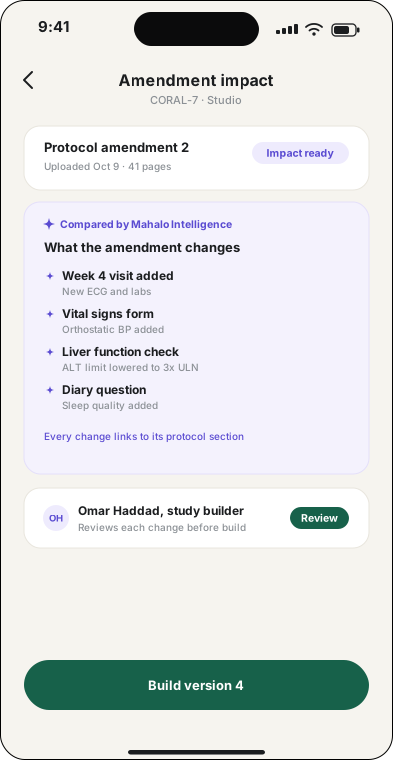
See the amendment impact
Mahalo Intelligence lists every change and links it back to the protocol section.
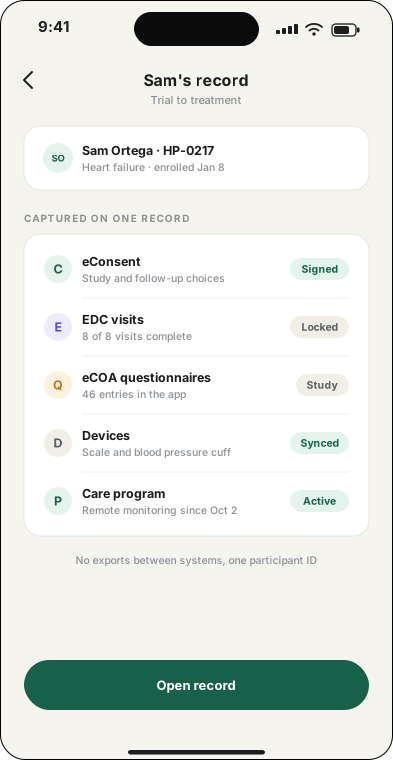
One participant record
eConsent, EDC, eCOA, devices and care all sit on one participant ID.
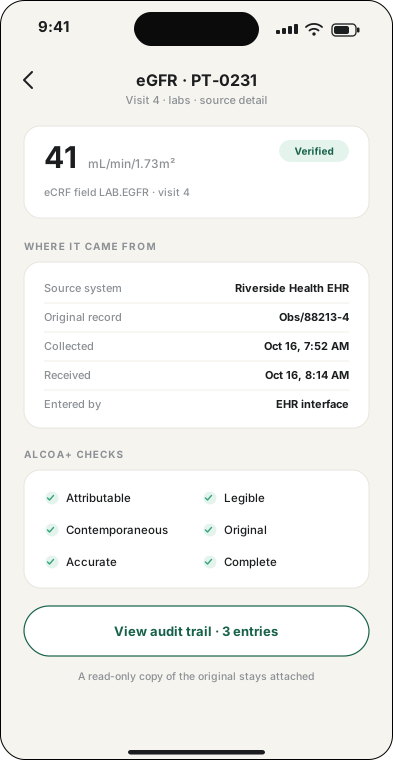
Every field has provenance
Each value shows where it came from, ALCOA+ checks and a full audit trail.
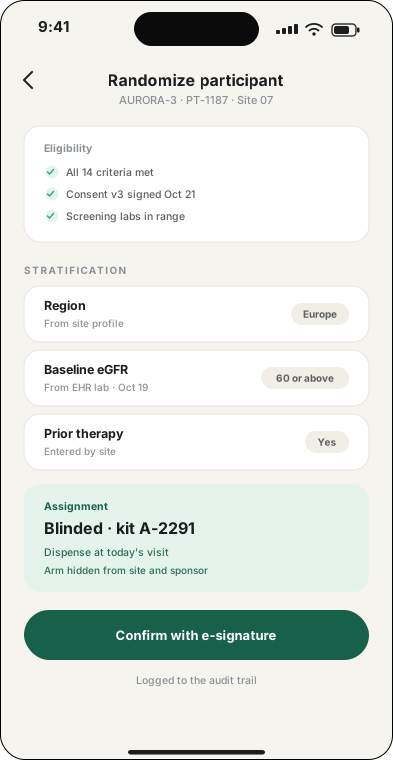
Blinded randomization
Confirm eligibility and randomize with blinded, stratified allocation and kit assignment.
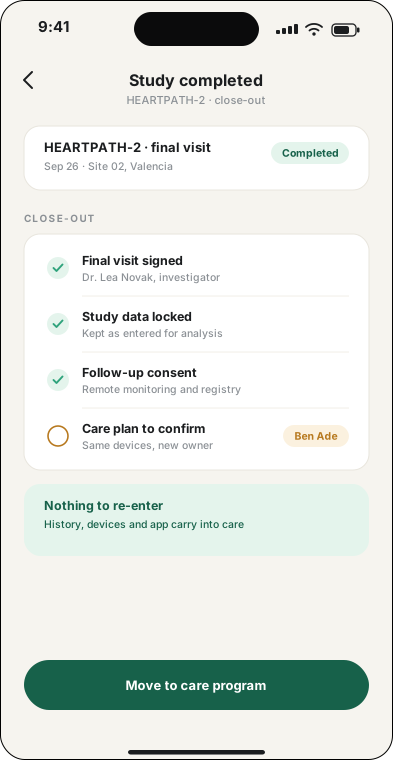
Study close-out
Study data locks for analysis, and history carries into care without re-entry.
Side-by-side comparison
| Dimension | Multi-vendor stack (Medidata or Veeva core plus point vendors) | Mahalo Health |
|---|---|---|
| Participant record | One per system, matched and reconciled by data management. Platform vendors reduce this inside their own products. | One participant record across recruitment, the trial and follow-up care. |
| Study build | Built per system, or once per vendor platform, then integrated with point vendors. | One study definition. Mahalo Intelligence drafts the build from the approved protocol; your designer confirms each element. |
| Protocol amendments | Each affected system is updated and revalidated, and the changes are lined up by hand. | The amendment names the forms that change, the participants who must re-consent and the kits affected. |
| Audit trail | One per system. | An audit entry is written in the same transaction as the change, on one trail. |
| Patient recruitment | Separate recruitment vendor, advertising, or coordinators reading charts by hand. | Recruit screens authorized EHR charts nightly against protocol rules, shows the evidence for each match and sends verified referrals; Noa handles outreach. |
| EHR data | Manual transcription or a separate EHR-to-EDC product. | Mapped EHR values are reviewed before they enter the study. Mahalo never writes back to the legal medical record. |
| Site experience | Often a login and workflow per sponsor system. Veeva offers SiteVault and VeevaID, and Medidata offers single sign-on for sites, to ease this inside their own platforms. | eISF, training records, delegation log and eSource live with the study. Access ends when the delegation does. Monitors get scoped live access. |
| Participant tools | eCOA, eConsent and device apps often come from different vendors. | App, eConsent, ePRO and BYOD run from the same record the site works in. |
| After the study | A separate remote monitoring or care vendor and a new patient record. | Mahalo Care runs RPM, RTM and chronic care on the same record. |
| AI | Added within each vendor's own products. Medidata, for example, uses AI to automate repetitive EDC setup tasks. | Mahalo Intelligence works across build, extraction and screening. People approve every final decision. |
| Getting started | Enterprise implementation. Veeva describes one biotech's primary implementation taking a year after the discovery phase, with the first study live in six months. | Start with one defined study, then add integrations, validation support and multi-country scale as the programme grows. |
| Security and compliance | Mature enterprise compliance programmes at both vendors. | Certified to ISO/IEC 27001:2022 and ISO 9001:2015. Configurable controls support 21 CFR Part 11 and ICH E6 GCP workflows. HIPAA and GDPR responsibilities follow Mahalo's role in each deployment. |
| Where the stack is stronger | Very large global drug programmes with central imaging and endpoint adjudication at their core; deep existing libraries and trained staff. | Mahalo works with central labs and enterprise pharmacovigilance rather than replacing them. |
Which should you choose?
Stay on Medidata or Veeva if you run a large global drug portfolio and your organisation has already standardised its libraries and staff on one of them. Medidata is the stronger fit where central imaging or endpoint adjudication drive your studies.
Choose Mahalo Health if your team is losing time to reconciliation between systems, recruitment is your bottleneck and your sites hold the patients in their EHRs, you need to start with one study without a year-long implementation, or your participants should continue into remote monitoring or care after the study.
Run both if you want to keep enterprise safety, central labs or an existing EDC standard for some programmes while moving newer, site-heavy or care-linked studies to one record. Mahalo is designed to hand off to those systems rather than compete with them.
Questions to ask any vendor
- How many separate participant records will exist for one person in my study?
- When the protocol is amended, which systems change, and who lines them up?
- Where does the audit trail live, and how many are there?
- How are patients found in the EHR, and who verifies each match?
- Do sites need a new login for my study?
- What happens to the participant's data and app when the study ends and care continues?
- Can I start with one study, and what changes when I scale?
See it on your own protocol
Bring a protocol and your current system list. We'll map what Mahalo replaces, what it runs with your partners and what stays where it is.
Sources
- Medidata, "Electronic Data Capture (EDC) Software – Medidata Rave": https://www.medidata.com/en/data-experience/edc-systems/
- Veeva, "Veeva Clinical Platform": https://www.veeva.com/products/veeva-clinical-platform/
- Veeva, "How to Adopt a Clinical Platform" (eBook, 2025): https://www.veeva.com/wp-content/uploads/2025/06/Clinical-Platform_eBook.pdf
- Mahalo Research: https://mahalo.health/research
- Recruit by Mahalo Health: https://mahalo.health/solutions/patient-recruitment
- Mahalo Care: https://mahalo.health/care
- Mahalo Trust Center: https://mahalo.health/trust