Mahalo Health publishes this guide and is one of the options in it. We built it in November 2026 from each vendor's public product pages, Veeva's own platform guidance, and Veeva reviews on G2 and Capterra. We did not run hands-on tests of other vendors' software. The comparisons are our opinion.
Key takeaways
- "Veeva Vault" covers several clinical products: eTMF, CTMS, EDC and CDMS, RTSM, eCOA, Study Startup, Payments and the free SiteVault eISF for sites. Decide which of them you are replacing before you compare vendors.
- Teams usually look elsewhere for three reasons: the size of an enterprise implementation, the admin effort to keep it configured, and quote-based pricing that assumes a large sponsor.
- Mahalo Health replaces nine trial systems on one participant record, adds EHR-based patient recruitment, and keeps participants on the same record if they move into a care program after the study.
- If you only need data capture, focused EDC vendors such as Medrio, Viedoc, Castor and OpenClinica are lighter options. Medidata and Oracle Clinical One are the enterprise alternatives.
- Veeva remains a strong choice for large sponsors that have standardised documents, operations and staff on Vault.
The short answer
Pick by the problem you are solving. If your team loses time reconciling separate systems, finding patients, or handing participants over to care after a study, choose a unified platform such as Mahalo Health. If you need an enterprise EDC with deep libraries for large global programmes, compare Medidata and Oracle Clinical One. If you only need data capture for smaller studies, look at Medrio, Viedoc, Castor or OpenClinica.
What Veeva does well
The Veeva Clinical Platform covers clinical operations (eTMF, CTMS, Payments, Study Startup, Site Connect, Study Training, Disclosures), clinical data (EDC and DQS), RTSM, eCOA, a free eISF for sites (SiteVault), single sign-on for researchers (VeevaID) and a patient app (MyVeeva for Patients) (Veeva).
Veeva's own guidance describes one large biopharma retiring over 100 systems on the platform (Veeva eBook). On G2, reviewers credit Vault for unified CTMS and eTMF, audit readiness and strong document management (G2). For a sponsor that already runs its documents and operations on Vault, those are real reasons to stay.
Why teams look for Veeva alternatives
- Implementation time. Veeva describes a global biotech whose primary implementation took one year after the discovery phase, with the first study live within six months (Veeva eBook). That pace suits a portfolio, not a single urgent study.
- Learning curve and admin effort. G2 reviewers mention rigid lifecycle workflows, many clicks to file eTMF documents, and custom reports that need a power user or system admin (G2).
- Cost for smaller teams. A Capterra reviewer calls Vault "a bit expensive for companies that are just starting off or are small" (Capterra). We did not find a public price list on veeva.com, so budgets start with a sales quote.
- What sits outside the platform. Finding patients in site EHRs and running care programs after the study still mean extra vendors and a new record for the same person.
The best Veeva alternatives in 2026
1. Mahalo Health: one record from recruitment to care
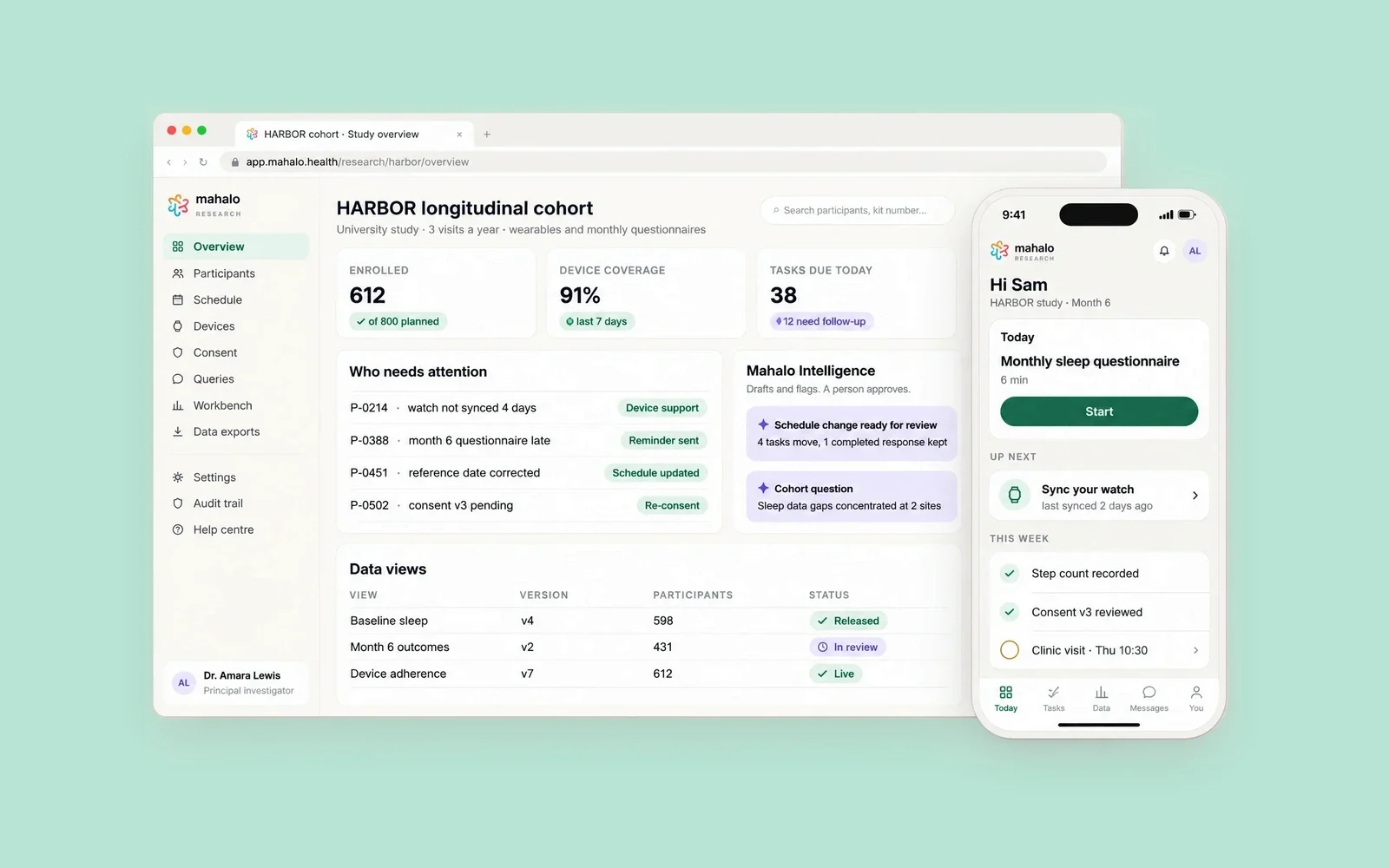
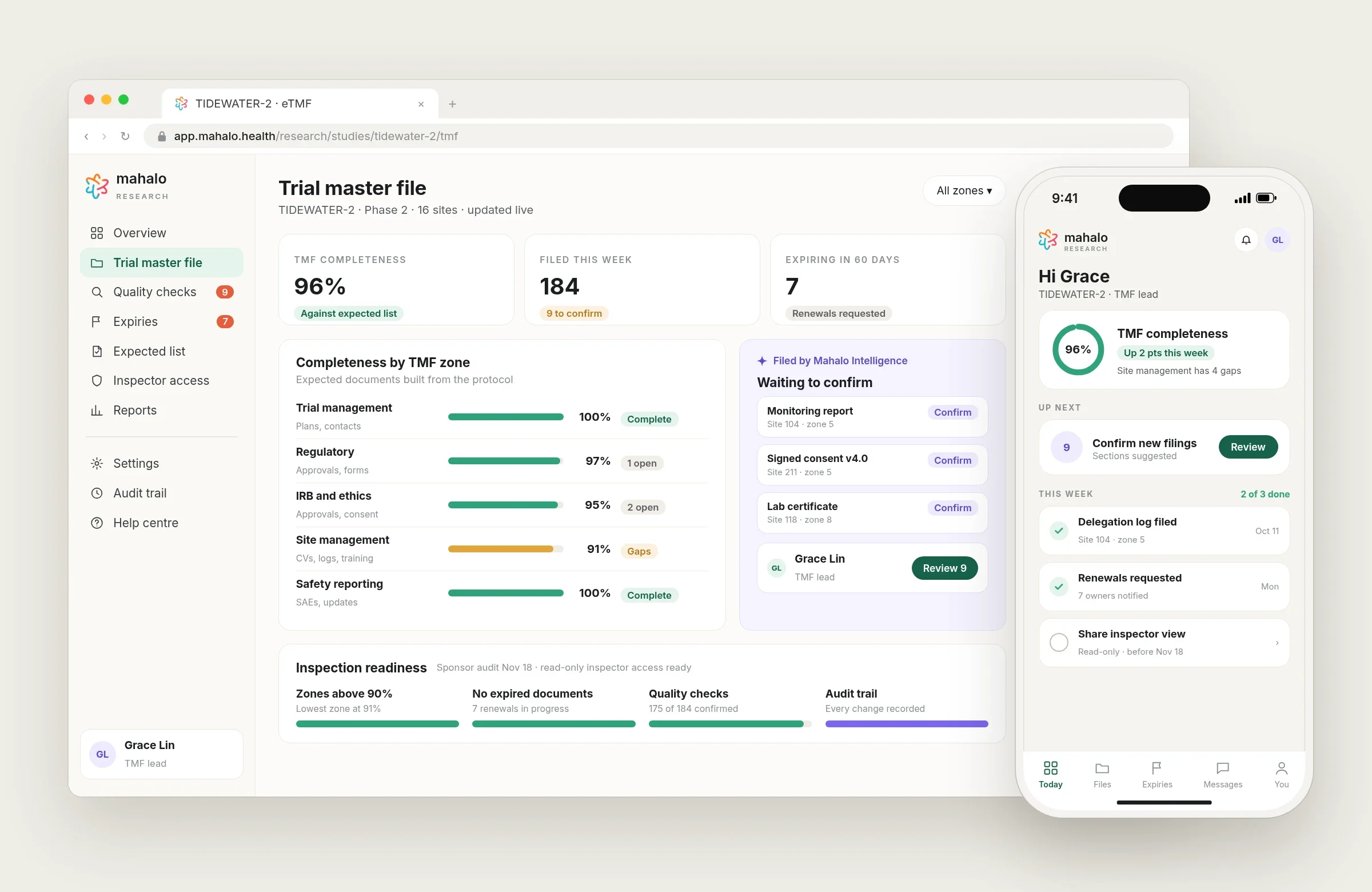
Mahalo Health is a clinical research and connected care platform. Mahalo Research replaces nine systems studies usually buy separately: EDC; CTMS for sponsor and site; eTMF and the site's own eISF; randomization and trial supply; eCOA and ePRO; eConsent; site eSource; site training records; and randomization by phone. It runs the workflow for central labs, site payments and enterprise pharmacovigilance while your partner keeps their system, and it connects to the EHR and to regulator and ethics portals.
- Mahalo Intelligence reads the approved protocol and drafts the study build: forms, visits and edit checks. Your designer confirms each element before anything runs.
- Recruit screens authorized EHR charts nightly against the approved protocol rules and shows the evidence for every match. A named person verifies every match. It connects to Epic, Oracle Cerner, athenahealth, eClinicalWorks, NextGen, ModMed, Veradigm, Greenway and MEDENT.
- Mahalo Care runs remote patient monitoring, remote therapeutic monitoring, chronic care management and virtual care on the same record, so a participant can move from a study into a care program without starting over.
- Certified to ISO/IEC 27001:2022 and ISO 9001:2015. Configurable controls support 21 CFR Part 11 and ICH E6 GCP workflows.
Best for: sponsors, CROs, academic teams and health systems that want to start with one study, find patients in site EHRs, or keep participants connected after the study.
Limitations: Mahalo works with central labs and enterprise pharmacovigilance rather than replacing them. Programmes built around central imaging or endpoint adjudication may be better served by Medidata.
Documents, data and sites on one record.
Six screens from one study, from protocol upload to inspection and care. Drag to explore.
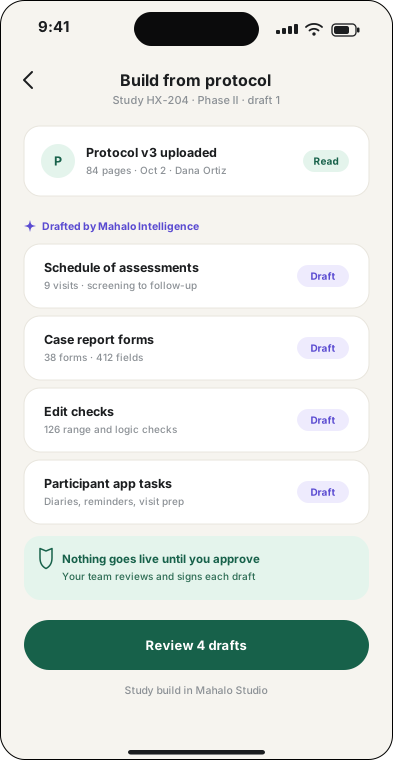
Build from protocol
Upload the protocol and Mahalo Intelligence drafts the study build for review.
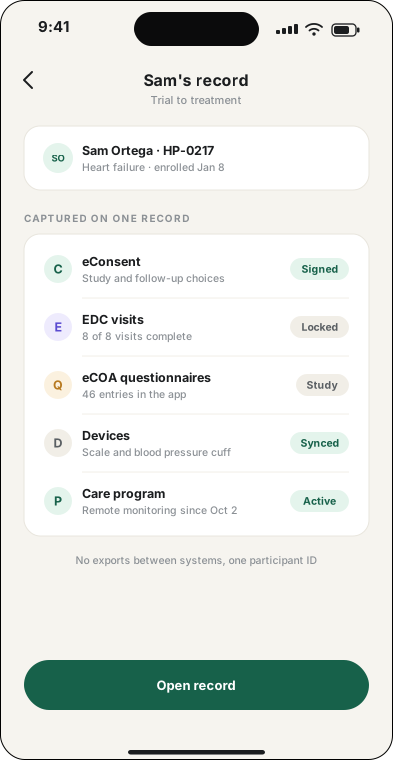
One participant record
eConsent, EDC, eCOA, devices and care all sit on one participant ID.
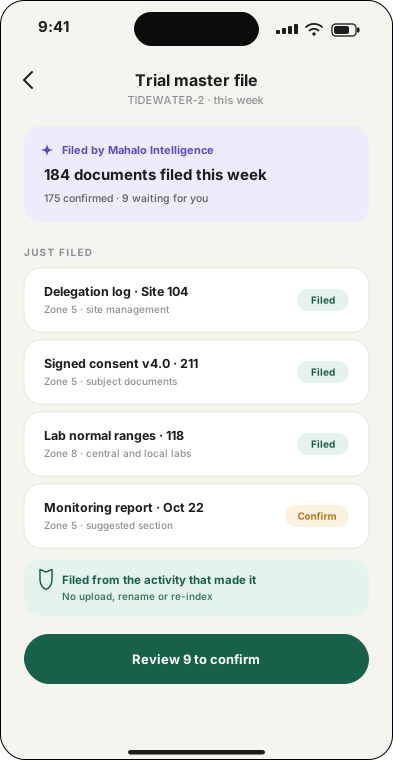
Filed automatically
Documents created by study activity land in the right TMF section.
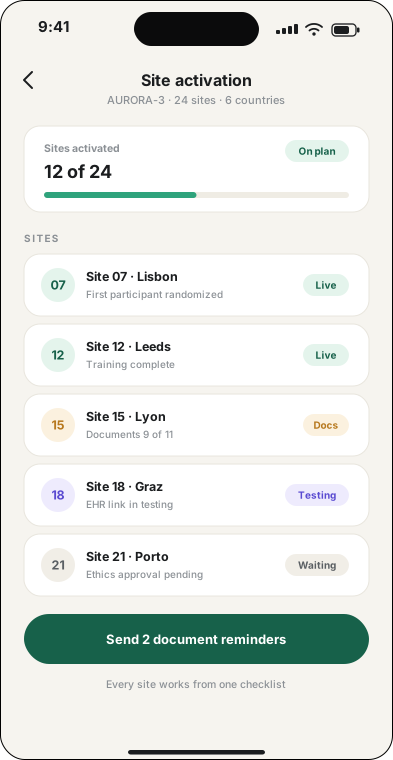
Site activation
See training, documents and system access for each site before activation.
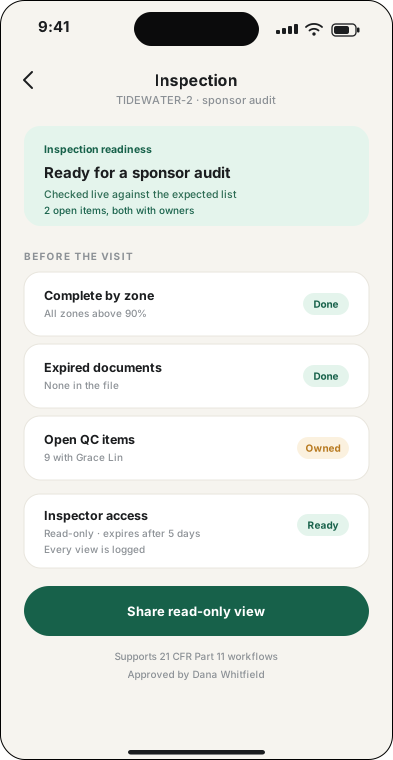
Inspection readiness
Readiness is checked live, and inspectors get time-limited, read-only access.
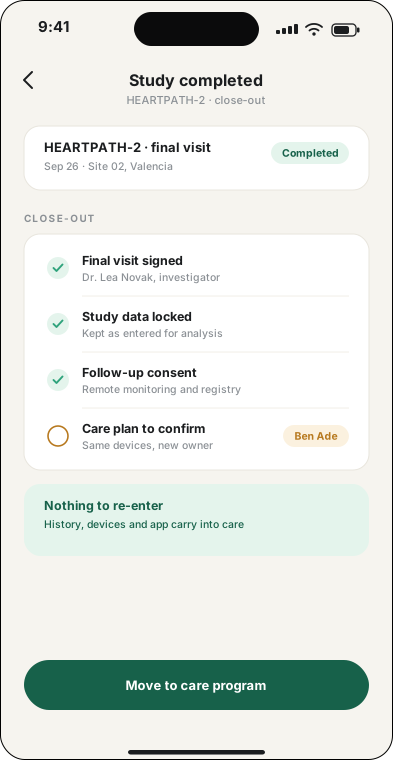
Study close-out
Study data locks for analysis, and history carries into care without re-entry.
2. Medidata: the enterprise EDC benchmark
Rave EDC is the centre of the Medidata Platform. Medidata says Rave aggregates and reconciles data from eConsent, eCOA, RTSM and imaging, and reports 1.8 million users and more than 38,000 studies on Rave EDC (Medidata).
Best for: large global drug programmes, especially where central imaging or endpoint adjudication sit at the centre of the study. Limitations: an enterprise purchase with an enterprise implementation; G2 reviewers mention high cost for small companies (G2).
3. Oracle Clinical One: data collection and RTSM on one platform
Oracle says Clinical One Data Collection captures data from EHRs, labs and patient applications on a single platform, and Clinical One RTSM handles randomization and trial supply on the same platform (Oracle).
Best for: sponsors that want data collection and randomization from one enterprise vendor. Limitations: the page we cite covers data collection and randomization only, so check which document and operations tools (eTMF, CTMS) you would still need.
4. Castor: EDC, eCOA and eConsent with AI extraction
Castor offers EDC, eCOA, eConsent and data management in one platform. Its Catalyst product uses AI to turn source documents and EHR data into structured records, and a human reviewer confirms every result. Castor reports 19,000+ studies and 900+ customers (Castor).
Best for: biotech, medtech and academic teams that want a self-service data platform. Limitations: its home page lists no CTMS or eTMF, so plan for operations to stay in other tools.
5. Medrio: no-code EDC for small and scaling teams
Medrio positions itself as the EDC for small and scaling clinical teams, with integrated EDC/CDMS, ePRO/eCOA, eConsent and RTSM that sponsors can configure without a programmer (Medrio).
Best for: small sponsors and CROs running studies without in-house programmers. Limitations: focused on clinical data; documents and site operations need other tools.
6. Viedoc: predictable, per-study pricing
Viedoc offers EDC, ePRO and televisits, prices per study with no per-seat fees, and reports a 10-week average study build (Viedoc).
Best for: teams that need a predictable budget for data capture. Limitations: a data-capture suite, not a replacement for Vault's eTMF or CTMS.
7. OpenClinica: modular eClinical for academic and mid-size teams
OpenClinica combines EDC, eConsent, eCOA, randomization, EHR-to-EDC, analytics and patient recruitment, and names university researchers, academic medical centers, sponsors and CROs among its users (OpenClinica).
Best for: investigator-initiated studies and small to mid-size sponsors. Limitations: its home page lists no eTMF or CTMS, so documents and operations stay in other tools.
Side-by-side comparison
| Option | Best for | Trial systems covered (vendor-stated) | EHR patient recruitment | Care programs after the study |
|---|---|---|---|---|
| Veeva Clinical Platform | Large sponsors standardised on Vault | eTMF, CTMS, EDC and CDMS, RTSM, eCOA, Study Startup, Payments, SiteVault eISF | Not on the platform page | Not on the platform page |
| Mahalo Health | Starting with one study; site-heavy or care-linked studies | EDC, CTMS, eTMF and eISF, RTSM, eCOA and ePRO, eConsent, site eSource, training records | Yes, with Recruit | Yes, with Mahalo Care |
| Medidata | Large global drug programmes | Rave EDC with eConsent, eCOA, RTSM and imaging data | Not on the Rave EDC page | Not on the pages cited |
| Oracle Clinical One | Enterprise data collection plus RTSM | Data collection, RTSM | Not on the page cited | Not on the pages cited |
| Castor | Self-service biotech, medtech and academic studies | EDC, eCOA, eConsent, AI data extraction | Not on the home page | Not on the pages cited |
| Medrio | Small and scaling teams | EDC/CDMS, ePRO/eCOA, eConsent, RTSM | Not on the home page | Not on the pages cited |
| Viedoc | Predictable per-study budgets | EDC, ePRO, televisits | Not on the home page | Not on the pages cited |
| OpenClinica | Academic and mid-size teams | EDC, eConsent, eCOA, randomization, EHR-to-EDC | Patient recruitment module | Not on the pages cited |
How to switch without disrupting live studies
- List which Vault applications you use today and which study each one supports.
- Keep live studies where they are. Moving a study mid-flight adds validation and reconciliation work.
- Pick one new study for the new platform and bring its protocol, data-management plan and system list to the evaluation.
- Agree which partner systems stay (central labs, safety database, regulator portals) and how data reaches them.
- Plan document retention for studies that close on Vault before you change contracts.
For a deeper look at how a single platform compares with a stack built around Medidata or Veeva, read Mahalo Health vs. multi-vendor clinical trial stacks built on Medidata and Veeva.
See it on your own protocol
Bring a protocol and your current Vault footprint. We'll map what Mahalo replaces, what it runs with your partners and what stays where it is.
Sources
- Veeva, "Veeva Clinical Platform": https://www.veeva.com/products/veeva-clinical-platform/
- Veeva, "How to Adopt a Clinical Platform" (eBook, 2025): https://www.veeva.com/wp-content/uploads/2025/06/Clinical-Platform_eBook.pdf
- G2, Veeva Vault reviews: https://www.g2.com/products/veeva-vault/reviews
- Capterra, Veeva Vault reviews: https://www.capterra.com/p/173465/Veeva-Vault/
- G2, Medidata Rave vs Veeva Vault: https://www.g2.com/compare/medidata-rave-vs-veeva-vault
- Medidata, "Electronic Data Capture (EDC) Software – Medidata Rave": https://www.medidata.com/en/data-experience/edc-systems/
- Oracle, "Clinical trial data collection": https://www.oracle.com/life-sciences/clinical-trial-data-collection/
- Castor: https://www.castoredc.com/
- Medrio: https://medrio.com/
- Viedoc: https://www.viedoc.com/
- OpenClinica: https://www.openclinica.com/
- Mahalo Research: https://mahalo.health/research
- Recruit by Mahalo Health: https://mahalo.health/solutions/patient-recruitment
- Mahalo Care: https://mahalo.health/care