Key takeaways
- The short answer: Medidata is stronger for large international drug programmes that need central imaging, endpoint adjudication and trial finance. Mahalo is the broader choice for academic longitudinal cohorts, digital intervention studies and research that continues into care.
- The real difference: Both offer study builders, AI and academic programmes. Mahalo keeps one approved study definition running through the participant app, devices, operations and analysis, on the same platform as Mahalo Care.
- AI: Both use AI to speed up study build. Mahalo Intelligence also extracts source-linked values, screens charts for recruitment and flags exceptions, and a named person approves every decision.
- Cost: Neither company publishes a per-study price. Compare quotes on build, changes, devices, testing and the staff time each arrangement leaves with your team.
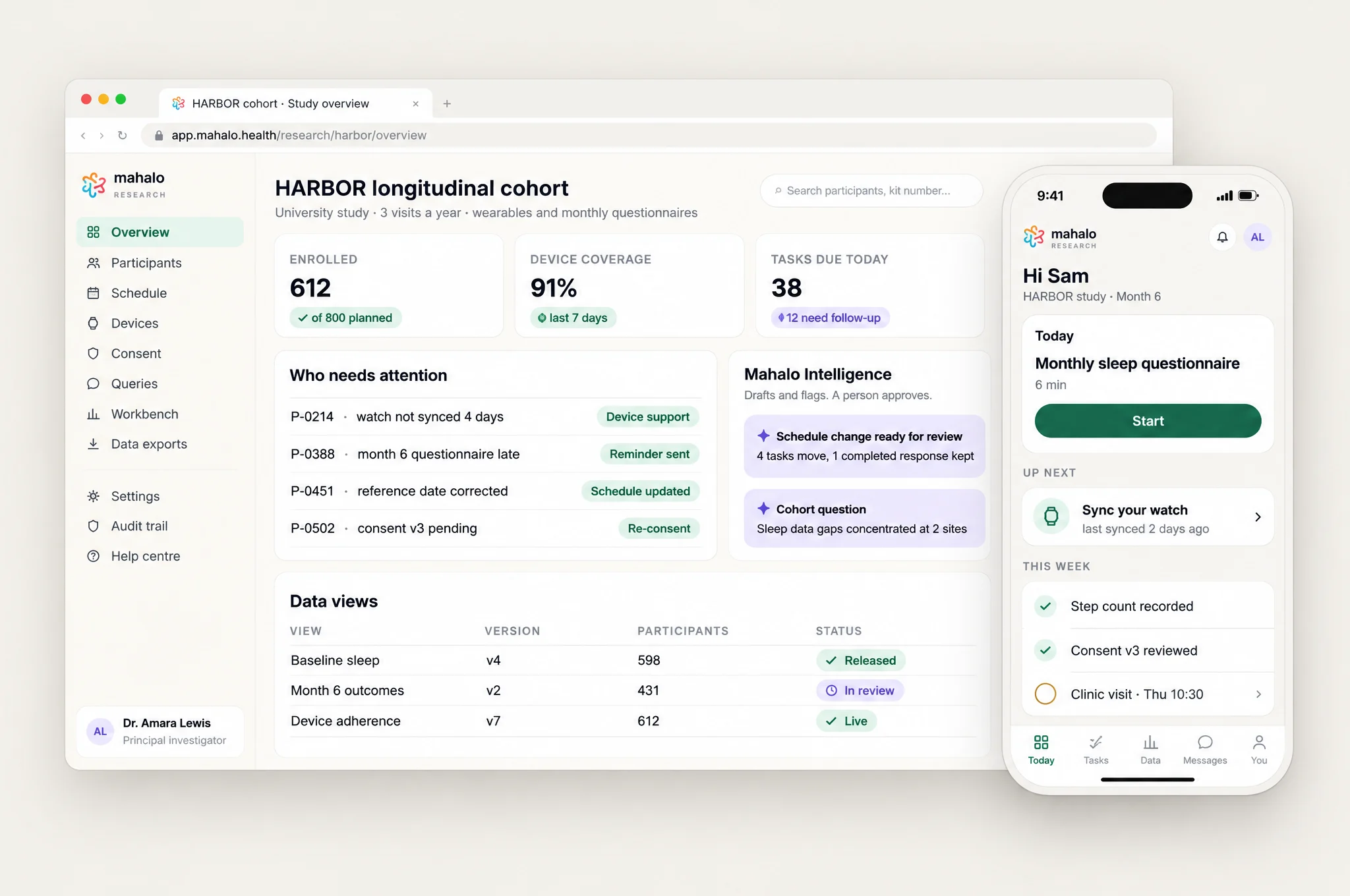
Academic research software has two jobs. It must capture data the investigator can trust, and it must make the study practical for the people running it. One platform can handle both a multinational drug trial and a longitudinal cohort, yet running those two studies feels very different.
A cohort coordinator may spend the morning finding participants whose watches stopped syncing, chasing an overdue questionnaire and moving a follow-up after a clinical event. An international trial manager spends the same morning on site activation, drug supply and payment milestones. Both need rigour. Their screens, staffing and most expensive sources of friction are different.
Mahalo puts research, participant engagement and connected care on one shared foundation. Medidata offers an extensive clinical research portfolio across data, patient and study operations. Both have study builders, AI and academic programmes. The difference shows when you follow a study from its first protocol decision, through daily work and into analysis. [1, 2]
Mahalo vs Medidata at a glance
The same criteria for both products, each from public product information.
| Criterion | Mahalo | Medidata |
|---|---|---|
| Best fit | Academic longitudinal cohorts, digital intervention studies and connected research that may continue into care | Large international drug programmes and portfolios that need specialist trial operations [2, 6] |
| Organising idea | Research and connected care on one shared data foundation | Patient, data and study experiences across a clinical trial portfolio [1, 2] |
| Study build | Mahalo Studio: visual builder, templates, workflows, communication rules, APIs and SDKs | Designer: central study definition, reusable libraries, change impact and AI-assisted build [4, 5] |
| Participant experience | One participant app for tasks, consent, devices, messages and intervention content | myMedidata, eCOA, Consent, sensors and registries [2, 15, 28] |
| AI | Mahalo Intelligence drafts study definitions, extracts source-linked values and flags exceptions; a named person approves | AI-assisted build and test cases in Designer; AI data review and audit-trail review in Clinical Data Studio [4, 8, 23] |
| EHR to study record | Reviewed EHR capture, plus Recruit chart screening with evidence for coordinators | Health Record Connect and Rave Companion; nothing reaches Rave until the site saves the form [19, 21, 31] |
| Analysis | Workbench: versioned data views, visible queries and controlled release | Clinical Data Studio, trial-to-real-world data linkage and historical comparators [22, 23, 25] |
| Specialist trial operations | Randomization, supply, safety, queries and study management in the core platform | Dedicated RTSM, CTMS, eTMF, Safety Gateway, imaging, adjudication and trial finance [2, 16, 17, 30] |
| Connected care | Mahalo Care adds remote monitoring and digital interventions on the same platform | Health-record data flows into trials through Health Record Connect [14, 19] |
| Academic delivery | Implementation support built around investigator-led programmes, with documented releases | Academic pricing, an enablement programme and 200+ education units for clients [6, 7, 20, 26] |
| Pricing | Scoped proposal across four Research models, from a focused study to an enterprise portfolio | Academic pricing for universities, hospitals and foundations; contact sales for a quote [7, 32] |
A small study can have demanding timing and relationship rules. A large portfolio can need specialist finance and imaging infrastructure.
Participant count alone explains little about which platform will reduce the team’s workload.
Where Medidata is stronger
Medidata’s clear advantage is the large international drug programme, where specialist operations sit around the trial.
Central imaging and adjudication
Studies with centrally read imaging endpoints or committee adjudication get a specialist reading environment inside the same vendor portfolio. [2, 17]
Trial finance
Site payments, grants, and participant payment and travel products suit multi-country programmes with many paid sites. [17]
If your study needs these, Medidata is the safer choice today. Most academic studies do not, and that is where the comparison turns.
Where Mahalo is stronger
For academic cohorts, digital interventions and research that continues into care, Mahalo covers more of the study in one place.
One study definition, end to end
The approved definition drives questionnaires, schedules, participant tasks and analysis views, so a change shows its consequences before release. [5, 8, 9]
See Mahalo StudioBuilt for research that happens at home, for years
Participant app, wearables with capture and sync context, and intervention content sit in one record across multi-year follow-up. [12, 28, 33, 36]
See longitudinal studiesAI that shows its work
Mahalo Intelligence drafts, extracts and flags with the source attached. A named person approves the decision, and the approval is logged. [8, 21]
See Mahalo IntelligenceResearch and care on one platform
A digital intervention can move from study to programme on the same foundation, with Mahalo Care for remote monitoring and ongoing support. [1, 14]
See Mahalo CareThe same AI governance carries into recruitment. In one published deployment, a national site network using Recruit cut manual chart review from 36 hours to 2.5 hours a month per protocol and reduced screen failures from 52% to 14%. [37]
Academic programmes running on Mahalo
Four published academic customer stories, from multi-year cohorts to participant and partner journeys. [33, 34, 35, 36]
SINGER
NUS and NUHS
A multi-year Singapore geriatric intervention trial in the FINGER lineage, run on a dedicated Mahalo Research environment.
Read the customer story
GDM-MAPS
National University of Singapore
Mother–child pairs followed to one year postpartum with continuous glucose monitoring and home assessments.
Read the customer story
EMBRACE-BLOOM
King’s College London
Separate participant and partner journeys, English and Spanish content, and repeated questionnaires in one environment.
Read the customer story
PREDICT
Institute of Mental Health, Singapore
A five-year depression cohort using eCOA, ePRO and study management, continued through a 36-month extension.
Read the customer story
Connected study design and why it matters
A study is a set of relationships. Consent decides which activities are allowed. Eligibility decides which path a participant follows. An allocation can switch on an arm-specific schedule. A reference date decides when a questionnaire opens. That questionnaire feeds a measure, and the measure belongs to a defined analysis population.
When these relationships are explicit, a change can be judged in context. The builder sees what depends on a date, a question or a consent version before an amendment goes out, and older observations stay attached to the definitions they were collected under.
Approved study definition
Drafted with Mahalo Intelligence, approved by a named person, compiled the same way every time
- Consent versionauthorizesActivities
- EligibilitychoosesParticipant path
- AllocationactivatesArm schedule
- Reference datesetsQuestionnaire window
- QuestionnairefeedsMeasure
- Measurebelongs toAnalysis population
Mahalo Intelligence drafts a study definition from the protocol. A named person reviews and approves it, and a deterministic compiler builds the study artefacts from that approved version, with every approval in the audit history. [8, 9] Questionnaire logic, schedules, participant workflows and analysis definitions stay linked, so teams can see the consequences of a change, review the affected parts together and release with a traceable history. For academic teams, that means less manual coordination and less dependence on technical staff as the study evolves. [10]
HARBOR cohort · Study design
HARBOR · Study design
Draft v4 · not yet releasedMahalo Studio · 7 activities across 5 visits · edits stay in draft until released
Sleep questionnaire
Questionnaire · 14 items · about 6 min
Medidata Designer also tackles connected configuration. It keeps one central study definition, offers libraries of approved forms and edit checks, highlights downstream effects on connected outputs, and uses AI to generate test cases and simulated inputs for human review. [4]
The real distinction is reach. Mahalo’s research-and-care environment brings participant interventions, remote observations and analysis into the same definition. Medidata Designer serves a portfolio with deep clinical trial execution. Ask which decisions, activities and outputs actually share the definition, rather than whether a platform calls itself integrated.
From a protocol to a participant’s next task
Study setup turns scientific language into behaviour. “Collect a monthly questionnaire” leaves questions open. Does the month start at enrolment, treatment start or a clinical event? Can a late enrollee complete an earlier assessment? How long does a form stay open? What happens if a reference date is corrected? Which version appears after an amendment?
These decisions shape the participant’s experience and how missing data is read. A participant who was never due an assessment needs a different status from one who ignored a reminder. Without that distinction, the coordinator’s contact list and the analyst’s completion rate can both mislead.
| Rule | Example requirement | What it changes |
|---|---|---|
| Within-form branching | Ask about frequency only after the participant reports a symptom | Shorter questionnaires with relevant follow-up |
| Cross-form dependency | Activate a follow-up instrument after a qualifying response | A controlled path between separate instruments |
| Event-based timing | Open an assessment six weeks after treatment starts | Scheduling tied to a meaningful event |
| Completion window | Accept responses for seven days after the due date | A clear line between due, late and expired |
| Linked participation | Give a partner a related schedule | Different journeys within one research relationship |
| Amendment version | Introduce a revised instrument at approved sites | Historical and current responses keep their context |
Mahalo Studio is a visual builder for questionnaires, tasks, workflows, communication rules and role-specific experiences. Teams start from templates and extend with APIs and SDKs. [5] Medidata’s builder curriculum covers cross-form branching, schedules of activities, workflows, notifications and testing with sample participants. Both can handle complex instruments. [11]
The practical advantage of a builder is the conversation it enables.
Investigators can walk through a working participant journey and spot a scientific ambiguity that a written requirements sheet hid. For academics, who operates the builder matters as much as what it can do. Some institutions want trained internal configuration teams. Others want the supplier to carry the technical work through launch.
Longitudinal studies are complex in their own way
Observational research often has fewer treatment workflows than a drug trial. Its complexity builds over time. Participants enrol on different dates, change devices, miss single activities, return after gaps or move into a new phase of follow-up.
Wearable studies add a second clock. A device can record continuously and upload occasionally, so data arriving today may describe last week. A dashboard that treats upload time as observation time distorts both follow-up and interpretation. Researchers need capture time, sync, expected coverage and the study window side by side.
HARBOR cohort · Devices
Devices
Last 7 daysHARBOR longitudinal cohort · 612 enrolled · wrist-worn watch, daily sleep and activity
Device coverage
91%
last 7 days
With gaps
54
participants
Coverage by site
Share of participant-days with sleep data, last 7 days
P-0214 · Site 01 Riverside Device support
Observation time and upload time are stored separately. Analyses use the day the data describes.
Mahalo’s wearable and digital biomarker tools keep source context, timestamps, data quality and algorithm history, linking an observed signal to the derived measure used in research. [12, 13] Medidata’s portfolio also includes sensors and decentralised study tools. Remote measurement is shared ground; the workflows around it decide how useful it is. [2]
One change
A reference date moves by ten days
Jun 1Jun 11
Before the original schedule
- Month 3Completed
- DiaryLate
- Month 6Dec 1
After future items shift by ten days
- Month 3Completed
- DiaryNot due yet
- Month 6Dec 11
Future tasks move
Month 6 questionnaire
Dec 1Dec 11
Completed response keeps its context
Month 3 answers stay with the original schedule.
Overdue item changes status
LateNot due yet
The reason is shown to the coordinator.
Reminders re-timed
Participant reminders follow the new dates.
Analysis view records which schedule applied
Each response can be read against the schedule that was in force when it was collected.
Picture a participant’s reference date moving by ten days. Future tasks may need to move, a completed response must keep its original context, and the coordinator must see why yesterday’s overdue item changed status. The analysis view also needs to know which schedule applied. That is the practical value of keeping relationships through a study’s history.
The researcher’s working day
A researcher’s first screen should answer one question: who needs attention, and why? Completion charts show a trend, but a coordinator also needs the reason for each participant, an owner for each follow-up and a record of what already happened.

Mahalo’s study management shows operational status from current study activity, including enrolment, readiness, milestones, query age and compliance signals, so the record of the work sits next to the worklist used to manage it. [10]
| Signal | The question behind it | The right action |
|---|---|---|
| Survey incomplete | Was it due, authorised and available? | Contact the participant or correct the configuration |
| Device data absent | Is the device disconnected, unsynced or outside the expected window? | Give the right device support |
| Query ageing | Who owns it, and what source information is missing? | Resolve or escalate that specific query |
| Recruitment below plan | Where are candidates leaving the workflow? | Fix screening, consent or scheduling friction |
| Cohort completeness changing | Did data arrive, eligibility change or the denominator change? | Read the trend with its definition |
Fewer steps between understanding an exception and acting on it means less load on a researcher’s working memory. Mahalo’s role-based views put the right part of the platform in front of each person. [5] Medidata also serves different users through its patient, data and study products. [2] Breadth only helps when the screen shows the slice that person needs.
Consent is part of the same day. When a protocol amendment needs re-consent, the participant should see what changed and decide on optional choices, while the coordinator sees who has signed which version. [29]
Participant experience is part of data quality
Participants meet the study through consent, tasks, reminders, questions and follow-up requests. A task at the wrong time, or a survey that repeats irrelevant questions, creates work for the participant and the research team.
A coherent experience puts the current activity, the expected effort and the route to help in one place, and keeps the context researchers need when a participant asks why something changed.
Hi Sam
HARBOR study · Month 6
Today
Monthly sleep questionnaire
About 6 min
Your answers help the team see how sleep changes across the year.
Up next
Monthly sleep questionnaire
In the last week, how often did you wake during the night?
Choose one
Your steps and sleep this month
From your watch · weekly averages
Steps a day
7,840
Sleep a night
6 h 50 min
Watch last synced 2 hours ago
Mahalo’s participant app covers study activities, communication and relevant health content, and Mahalo Care extends into remote monitoring and digital interventions. [14, 28] Medidata’s myMedidata, eCOA and registry products cover participation before, during and after a study. [2, 15]
In a digital intervention study, the content participants receive can be the intervention itself. Researchers need to know which material was approved, when it changed and who could receive it, so the content workflow carries scientific as well as operational weight.
Content · Sleep coaching module
Content · Sleep coaching module
StudioHARBOR longitudinal cohort · 3 lessons · edits are versioned and released only after approval
Lessons
Lesson 1
Why sleep timing matters
Lesson 2
Wind-down routines
Lesson 3
When to talk to your doctor
Add lesson
Lesson 1
Why sleep timing matters
Your body runs on a daily clock. Going to bed and waking up at about the same time helps that clock stay steady.
Big swings, like staying up late on weekends, can make weekday mornings feel harder.
Try this week: pick a wake-up time and keep it, even on days off.
Change log
Participant preview
Sleep coaching · Lesson 1 of 3
Why sleep timing matters
Your body runs on a daily clock. Going to bed and waking up at about the same time helps that clock stay steady.
Try this week: pick a wake-up time and keep it, even on days off.
AudienceIntervention arm only
Released to 312 participants
Fourteen systems across the clinical trial lifecycle
Sponsors, CROs and academic trials units often buy these fourteen categories separately. The map below shows how each platform covers them, separating core product coverage from specialist functions and external services.
14 systems, one foundation
Start-up
- Clinical trial management
- Regulatory and ethics workflow
- Electronic trial master file
- Training
Enrol
- Electronic consent
- Randomization and supply
Collect
- Electronic data capture
- Electronic outcomes
- Laboratory data
- Site source and EHR
- Telephone response
Protect
- Trial safety
- Imaging and adjudication
Close out
- Payments
One study definition · one participant record · one audit trail
Mahalo Research
| System | Mahalo | Medidata |
|---|---|---|
| Electronic data capture | Forms, participant and site entries, review and governed exports | Rave EDC with data-management tools |
| Clinical trial management | Study operations linked to enrolment, visits and review activity | CTMS and study operations products |
| Electronic trial master file | Study documents, approvals and audit history in the platform | Dedicated eTMF and end-of-study site archiving |
| Randomization and supply | Allocation, stratification, blinding, emergency unblinding and kits | Dedicated RTSM |
| Electronic outcomes | eCOA, ePRO and participant assessments | Dedicated eCOA |
| Electronic consent | Versioned consent and participant permissions | Medidata Consent |
| Laboratory data | Results ingestion, terminology mapping and study data integration | Rave lab administration and clinical data intake |
| Trial safety | AE and SAE records with MedDRA and WHODrug coding, review and escalation | Safety Gateway for AE and SAE exchange as E2B files |
| Imaging and adjudication | Assessments inside study records; specialist central reading is arranged as a separate service | Imaging and Adjudicate |
| Site source and EHR | Source capture and reviewed EHR workflows | Rave Companion and Health Record Connect |
| Telephone response | Channel configured per study | Channel configured per contract |
| Payments | Scoped per study; Medidata’s dedicated finance products go further here | Site Payments, grants, and participant payment and travel |
| Training | Builder enablement and programme training | Education, certification and academic enablement |
| Regulatory and ethics workflow | Approval evidence, audit history and governed data releases | Regulatory tracking, eTMF and safety exchange |
A feature count is an incomplete measure of fit. A trial with a centrally read imaging endpoint benefits from a specialist reading environment. An academic cohort gets more daily value from usable surveys, reliable device follow-up and an analysis environment. Both need a dependable clinical record.
HARBOR cohort · Site 01 visits
Site 01 Riverside · Visits
Window rules from design v3338 participants · showing 6 · coordinator Priya Nair · status as of Mar 1, 2026
P-0451 · Month 6
Clinic visit · Feb 11, 2026
Clinic entry · Priya Nair
Clinic entry · Priya Nair
Clinic entry · Priya Nair
Lab import · terminology mapped
Every change keeps who, when and why in the audit trail.
HARBOR cohort · Queries
Data review
Month 6 data cutHARBOR · 23 open · 9 answered · 412 closed since baseline · median age of open queries 4 days
Q-1042 · Diastolic BP
ValueTom Okafor · Data manager · Feb 13, 10:14
Diastolic BP 28 looks like a typo. Please confirm against source.
Priya Nair · Site 01 coordinator · Feb 14, 09:02
Source sheet shows 82. Digits were swapped at entry. Corrected.
Tom Okafor · Data manager · Feb 14, 11:30
Correction matches source. Closing the query.
Closed by Tom Okafor · reason and both values kept in the audit trail
Review and sign-off
P-0451 · Month 6 visit
- Data enteredPriya Nair · Feb 11
- Queries closed1 of 1 · Feb 14
- Monitor reviewedSource checked · Feb 19
- PI signedDr. Amara Lewis · e-signature · Feb 20
Locked
Month 6 data cut locked by Tom Okafor
Feb 22, 2026 · 431 participants
AI from study design to research insight
AI earns its place when its output is tied to a clear task. A draft schedule, an extracted lab value or a proposed eligibility match is useful because a reviewer can check the source and decide what happens next.
Mahalo Intelligence drafts from the protocol, extracts from clinical documents with confidence scores and links every value to its source for review. Recruit carries this into eligibility screening with coordinator-reviewed matches, and Workbench brings questions about study data into a governed analysis environment. In every case, AI drafts, extracts and flags, and a named person approves. [8, 21, 22]
HARBOR cohort · Mahalo Intelligence
Mahalo Intelligence
3 items for reviewDrafts and flags for the HARBOR team. Each item links to its source and waits for a named approver.
Lab report · P-0451
Page 2 of 3Uploaded by Priya Nair · Feb 12, 2026 · Month 6 visit
Riverside clinical laboratory · specimen collected Feb 11, 2026
Highlighted line is the source of the extracted value
Mahalo Intelligence · Protocol draft
Study definition drafted from protocol v1.3
42 activities · 6 schedules · draft only, not released
Diff vs template
Mahalo Intelligence · Source-linked extraction
HbA1c 5.9% Confidence: High
P-0451 · Month 6 · mapped to the study's HbA1c item
“HbA1c (NGSP) 5.9 % ref 4.0–5.6”
Lab report, page 2, line 14
Mahalo Intelligence · Human approval
Awaiting approval from Dr. Amara Lewis
Principal investigator · requested Feb 28, 2026
AI drafts, extracts and flags. A named person approves.
| Task | Mahalo | Medidata | Why it matters |
|---|---|---|---|
| Study build | Drafts the study definition and artefacts from the protocol for review | AI-assisted build in Designer | Less effort starting from a protocol |
| Change analysis | Shows relationships and proposed changes inside the study workflow | Downstream impact awareness in Designer | Earlier view of affected activities |
| Clinical source extraction | Structured values linked to the source passage, with confidence | EHR-to-EDC through Companion and Health Record Connect | A traceable route from source to record, by different mechanisms |
| Recruitment | Protocol-to-chart screening with evidence for coordinator review | Registry prescreening and patient engagement | Different routes to an eligible population |
| Data review | Governed review workflows and study-data assistance | Clinical Data Studio and Coder+ | Human review focused on data quality |
| Analytical questions | Workbench with visible queries on governed data | Clinical data and historical evidence products | Answers read in the context of the dataset |
An AI answer about study data should keep the population, time window and data definition behind it. “Completion improved” means little until the reader knows what was due, who was included and whether late data changed the result. The best assistant helps the investigator inspect those definitions.
The same applies to participant support. In a study that evaluates digital support as part of an intervention, the conversation, the escalation path and the content version all shape exposure to the intervention. A research platform has to keep the link between what was delivered and what was measured.
My watch stopped syncing after the update. Do I still need to wear it?
I also had a fall last week
Study team view
Escalation · P-0388
Opened from Messages · today 9:42
"I also had a fall last week"
- Reason
- Possible adverse event mentioned
- Content version shown
- v5
- Assigned
- Priya Nair · due today
Mahalo Intelligence
Flagged, did not advise
The assistant stopped at the safety topic. Priya decides the next step.
Assistant rules for HARBOR
- Answers only from approved study content
- Shows the content version with every answer
- Safety topics always go to a person
Cohort exploration and analysis
Operational data changes as a study runs. A scientific result needs a stable account of the data and method behind it. The two meet when a researcher spots a pattern in a live cohort and wants to analyse it reproducibly.
Mahalo Workbench offers versioned data views, no-code exploration, specialist analysis and controlled release of results inside the research environment, so a finding stays connected to the data that produced it. [22]
HARBOR cohort · Workbench
Mahalo Workbench
Data cut Feb 22, 2026Governed analysis on versioned data views · every query and release is kept with its data cut
Data views
Baseline sleep
Month 6 outcomes
Device adherence
Views are built from locked data cuts. Older versions stay reproducible.
Where are sleep data gaps concentrated?
Generated query · read-only · uses observation date, not upload date
SELECT site, week_start,
  ROUND(100.0 * COUNT(*) FILTER (WHERE sleep_min IS NULL)
        / COUNT(*), 1) AS gap_rate
FROM harbor.device_adherence_v7
WHERE observed_on BETWEEN '2026-01-26' AND '2026-02-22'
GROUP BY site, week_start
ORDER BY site, week_start;
Gap rate by site and week
Gap days per 100 participant-days
Month 6 outcomes
Release v2 · needs reviewer approval
- Population
- enrolled, consented, ≥1 device day
- Data cut
- Feb 22, 2026
- Reviewer
- Dr. Amara Lewis
Medidata Clinical Data Studio focuses on clinical data integration, review and quality. Medidata’s evidence portfolio also links trial data to real-world data and offers historical trial comparators, which matter when the research question depends on an external population. [23, 25]
| Stage | The researcher’s question | Context to keep |
|---|---|---|
| Daily insight | Who needs follow-up today? | Current tasks, consent and activity history |
| Cohort exploration | Where are gaps concentrated? | Population definition and expected observations |
| Analytical preparation | Which records belong in this analysis? | Eligibility rules, exclusions and a defined data cut |
| Reproducible analysis | How was this result produced? | Code or query, data version and analytical decisions |
| Release | Which outputs can be shared? | Review and an attributable output |
Connecting these stages gives continuity. A researcher can move from an operational concern to a scientific question and keep the definitions that make the answer meaningful.
Building capability inside the university
Universities differ in technical capacity. Some run experienced trials units with dedicated data managers and study builders. Others form small teams around single grants. Both can use sophisticated software, but the work is shared differently.
Mahalo Studio offers templates and visual configuration, with extensibility for specialist needs. Mahalo’s academic work centres on investigator-led programmes, and its operating model documents customer feedback, design work and controlled releases. That supports both collaborative implementation and internal configuration. [5, 6, 26]
Medidata has a substantial academic offering, with sector pricing, staff enablement and professional services. Its academic fact sheet describes training institutions to build studies, with programme support, project management and mentorship. A university that wants a repeatable internal build team can benefit from that model. [7, 20, 27]
| Scientific intent | Questionnaire behaviour | Scheduling | Launch | Operation | Amendment |
|---|---|---|---|---|---|
| Research team | |||||
| Defines outcomes, eligibility and purpose | Approves wording and interpretation | Defines events and windows | Approves the participant experience | Engages participants, reviews decisions | Approves scientific changes |
| Implementation team (internal builders or Mahalo) | |||||
| Surfaces ambiguities | Configures branches and dependencies | Implements timing, reminders, exceptions | Builds, rehearses, supports release | Resolves configuration and technical issues | Assesses impact, implements release |
- Research team
- Implementation team (internal builders or Mahalo)
Scientific intent
- Research team
- Defines outcomes, eligibility and purpose
- Implementation team
- Surfaces ambiguities
Questionnaire behaviour
- Research team
- Approves wording and interpretation
- Implementation team
- Configures branches and dependencies
Scheduling
- Research team
- Defines events and windows
- Implementation team
- Implements timing, reminders, exceptions
Launch
- Research team
- Approves the participant experience
- Implementation team
- Builds, rehearses, supports release
Operation
- Research team
- Engages participants, reviews decisions
- Implementation team
- Resolves configuration and technical issues
Amendment
- Research team
- Approves scientific changes
- Implementation team
- Assesses impact, implements release
Shared this way, investigator attention is protected. Researchers still make the decisions that define the study, and technical specialists carry the configuration that makes those decisions behave consistently.
Pricing and the cost of delivery
Neither company publishes a per-study price. Medidata offers academic pricing to universities, hospitals, government agencies and foundations on request. [7] Mahalo scopes a proposal across four Research models: a focused study, a growing research programme, complex research and an enterprise portfolio. [32] So compare complete quotes, not list prices.
| Cost component | Why it varies |
|---|---|
| Platform access | Modules, sites, participants, study term and institutional scope |
| Initial study build | Protocol translation, instrument configuration and schedule design |
| Instruments and languages | Licences, translations and administration rules |
| Technical connections | Devices, source systems, identifiers and data delivery |
| Study testing | Representative journeys, edge cases and amendment behaviour |
| Ongoing changes | Revisions to forms, schedules, workflows and outputs |
| Researcher time | Meetings, configuration, testing, reconciliation and support |
| Analysis and close-out | Data preparation, governed outputs, archive and transfer |
A close implementation relationship can shorten the path from a researcher’s question to a working example. The same people understand the original intent, catch the downstream consequence and explain the trade-off, and that continuity matters over a multi-year programme. Mahalo’s academic offer is built so investigators can deliver programmes without managing separate integrations. [6] A larger provider brings a wider service organisation and standard processes, with personal involvement set by the contract.
The economic question is how much work the selected arrangement assigns to the academic team.
Public information does not establish a universal response time, price premium or flexibility ranking between the two companies. The full cost includes academic staff time as well as vendor invoices.
When to choose each
| Research setting | Mahalo | Medidata | Fit |
|---|---|---|---|
| Longitudinal cohort | Participant continuity, remote data, workflows and analysis in one place | eCOA, sensors, registries and academic support | Leans Mahalo |
| Digital intervention | Intervention delivery alongside observation and follow-up, with a path into care | Clinical trial capture and patient engagement | Leans Mahalo |
| Academic interventional trial | EDC, allocation, consent, outcomes and study operations | Established trial portfolio and specialist operations | Either can fit |
| Device or usability research | Human factors workflows and use-error traceability | MedTech trial tools, imaging and adjudication | Either can fit |
| Institution with internal builders | Templates, visual configuration and extensibility | Academic enablement, reusable objects and builder training | Either can fit |
| International drug programme | Configurable core trial and participant workflows | Trial finance, supply, imaging and portfolio infrastructure | Leans Medidata |
Choose Medidata if
- Your endpoint depends on central imaging reads or committee adjudication.
- You pay many sites across countries and want grants and payments in the same vendor.
- Your institution already runs Rave and wants to grow an internal build team through Medidata’s academic enablement.
Choose Mahalo if
- Your study runs for years at home, with wearables, questionnaires and participant support.
- The intervention is digital, or the study may continue as a care programme.
- You want AI to draft and flag, with a named person approving each decision.
- Your team would rather spend its time on participants and science than on configuration.
For academic teams combining longitudinal measurement, participant support and data exploration, Mahalo concentrates the capabilities they need. A study decision flows into the participant experience, the operational record and the analysis view, and the university chooses how much implementation work to keep.
Medidata remains a strong option in academic research. Its build tools, academic enablement and specialist trial products cover many of the same needs, with particular depth for large clinical development programmes.
Mahalo’s strongest case is how its products and delivery fit together. A university gets sophisticated research infrastructure while arranging the work around its researchers’ time, so they can concentrate on participants and science. Read more in our Medidata alternatives guide, the Medable alternatives guide and Mahalo for academic research.
About this comparison
Written by Mahalo Health from public product pages, vendor training materials and published academic offerings. It compares described functions and what they mean for academic work. Product screens are illustrative, use synthetic data and show no participant information or reported results. Diagrams and scenarios are editorial illustrations. Judgments concern documented scope and fit, not a controlled performance or usability benchmark. Medidata, Rave and related names are trademarks of their owners.
Want this as a PDF to share with your team? Download the white paper.
Sources
- Mahalo platform overview · Mahalo
- Medidata product portfolio · Medidata
- Mahalo Research · Mahalo
- Medidata Designer · Medidata
- Mahalo Studio · Mahalo
- Mahalo for academic research · Mahalo
- Medidata academic and not-for-profit offering · Medidata
- Mahalo Intelligence · Mahalo
- Mahalo healthspan trials: approved definitions and the deterministic compiler · Mahalo
- Mahalo study management · Mahalo
- Medidata Study Design and Build Essentials for Designer eCOA, course outline (PDF) · Medidata
- Mahalo wearables and devices · Mahalo
- Mahalo digital biomarkers · Mahalo
- Mahalo Care · Mahalo
- Medidata patient registries · Medidata
- Mahalo randomization and trial supply · Mahalo
- The Medidata Platform eBook, including clinical trial finance (PDF) · Medidata
- Medidata Safety Gateway · Medidata
- Medidata Health Record Connect · Medidata
- Medidata Global Education and Training course catalogue · Medidata
- Recruit by Mahalo Health · Mahalo
- Mahalo Workbench · Mahalo
- Medidata Clinical Data Studio · Medidata
- Dassault Systèmes AI momentum release, Feb 2026 (PDF) · Medidata
- Medidata AI synthetic control arm eBook (PDF) · Medidata
- The Mahalo Way · Mahalo
- Medidata academic clinical trials fact sheet (PDF) · Medidata
- Mahalo participant app · Mahalo
- Mahalo eConsent · Mahalo
- Mahalo safety and adverse events · Mahalo
- Mahalo EHR integration · Mahalo
- Mahalo pricing · Mahalo
- Customer story: SINGER, NUS and NUHS · Mahalo
- Customer story: GDM-MAPS, National University of Singapore · Mahalo
- Customer story: EMBRACE-BLOOM and GLUCO-CGM, King’s College London · Mahalo
- Customer story: PREDICT, Institute of Mental Health, Singapore · Mahalo
- Recruit cardiology case study · Mahalo